
Shareasale Alternatives for Vetted Affiliate Programs List for Digital Marketers
Discover top ShareASale alternatives and a curated, vetted affiliate programs list for digital marketers. Compare SaaS tools, high-ticket CPAs, and terms.
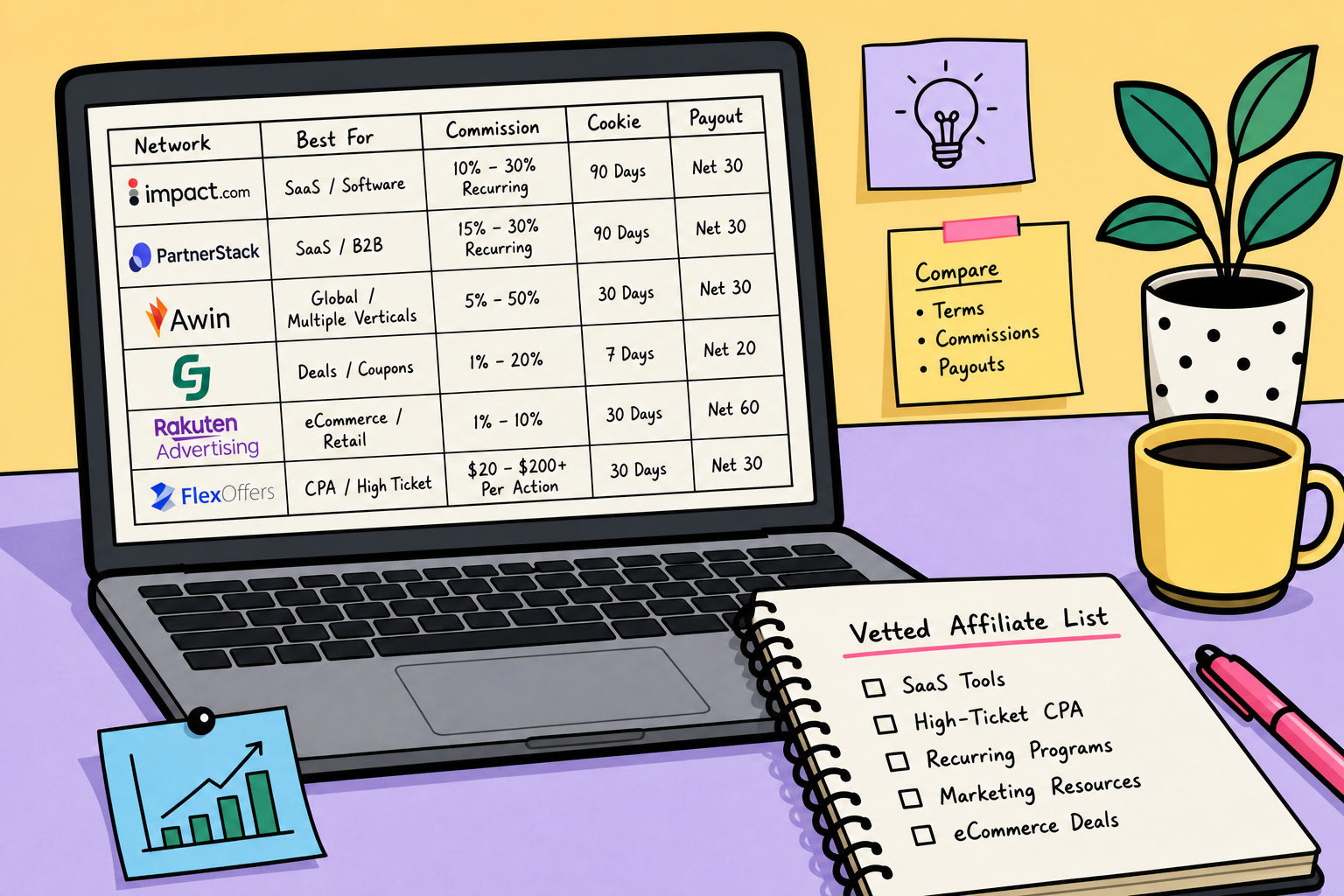
- The ShareASale Problem: Why Marketers Are Looking for Alternatives
- The Directory Approach: Transparent Access to Vetted Data
- The 5-Point Framework for Vetting Affiliate Programs
- The Ultimate Vetted Affiliate Programs List for Digital Marketers
- Strategic Niches for B2B and SaaS Programs
- How to Build a Portfolio of Vetted Programs Without Spreading Yourself Thin
- Advanced Promotion Channels for Digital Marketing Offers
- Common Traps in "High-Paying" Affiliate Offers
- FAQs on Vetted Affiliate Programs
- Moving Forward Without the Clutter
If you have spent any meaningful amount of time monetizing traffic, you know the exact friction of legacy affiliate networks. You sign up for a platform like ShareASale, navigate an interface that feels permanently stuck in 2012, and blindly apply to merchant programs. You wait days for approval. When you finally get in, you discover the merchant offers a measly 2% commission, a 7-day cookie, and creatives that haven't been updated since the Obama administration.
This "black box" approach to affiliate marketing is exactly why digital marketers, niche site operators, and content creators are seeking modern alternatives. You shouldn't have to hand over your website analytics, tax information, and a written promotional plan just to find out if an affiliate program is worth your time.
Today’s digital economy moves faster than legacy platforms can accommodate. Marketers need immediate, transparent data on commission structures, payout terms, and conversion potential to make strategic decisions.
In this guide, we are breaking down the shift away from closed legacy networks, how to properly vet an affiliate offer, and where to find a truly vetted affiliate programs list for digital marketers.
The ShareASale Problem: Why Marketers Are Looking for Alternatives
ShareASale, Rakuten, and CJ Affiliate paved the way for performance marketing. For over two decades, they acted as the necessary middlemen between merchants and publishers. However, as the industry matured—particularly in the SaaS and digital product sectors—the limitations of these platforms became glaring bottlenecks.
The Registration Wall
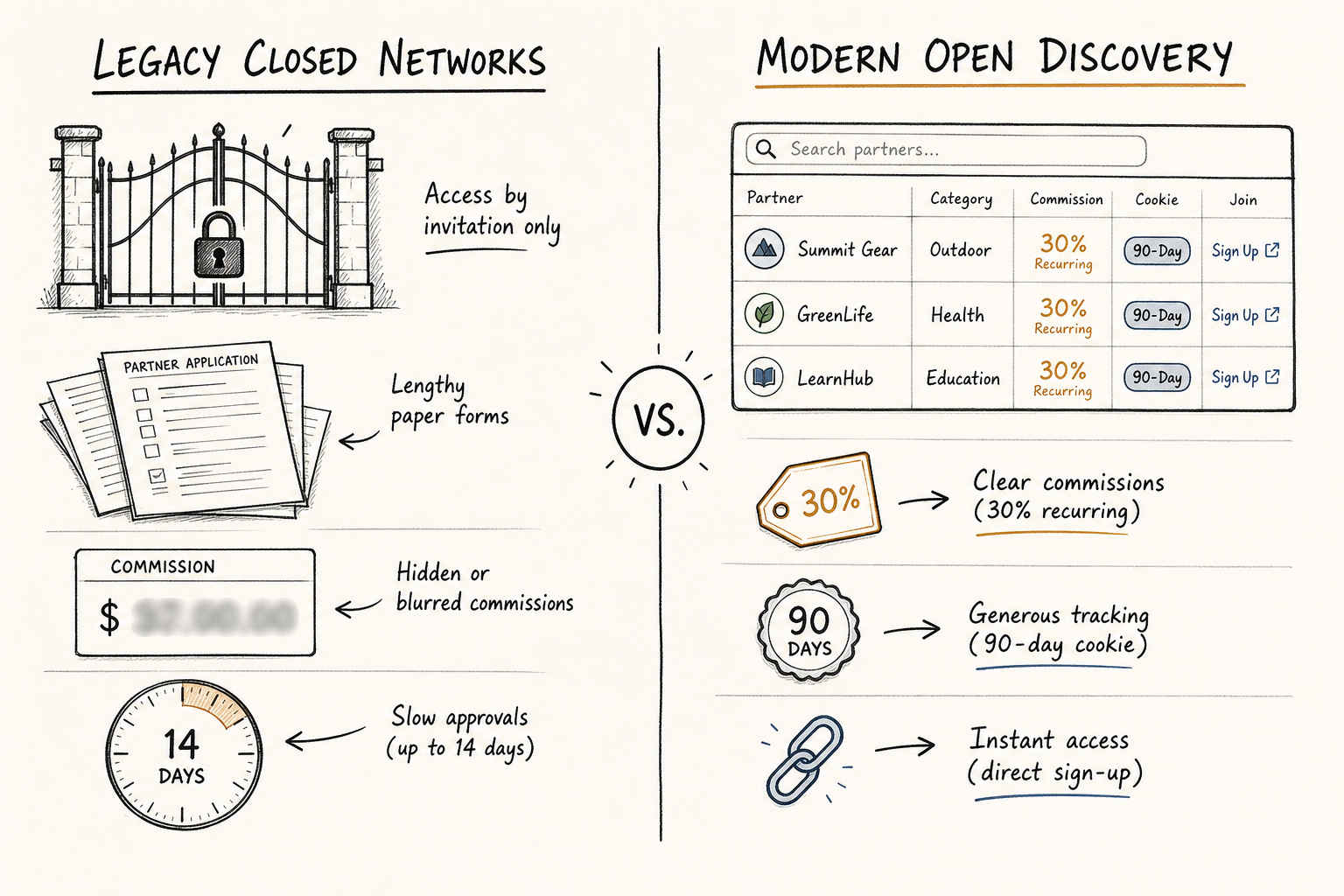
Most traditional networks require a rigorous application process just to join the network. Once inside, you face a secondary application process for every individual merchant. This double-gated system prevents you from efficiently comparing offers. You cannot easily evaluate if Merchant A's 15% revenue share is better than Merchant B's $50 flat CPA (Cost Per Action) because the terms are often hidden until you are approved.
Skewed EPC (Earnings Per Click) Data
Legacy networks lean heavily on network-wide EPC metrics to rank their merchants. The problem? These metrics are easily distorted. If a merchant allows coupon sites and trademark bidders to flood their program, the network EPC looks artificially inflated. A content creator writing high-quality tutorials will rarely see the same EPC as a massive coupon aggregator intercepting bottom-of-the-funnel traffic.
Cluttered UI and Stale Programs
Many traditional networks are graveyard platforms for abandoned affiliate programs. Merchants set up their tracking, launch the program, and then fire their affiliate manager. The program remains active on the network, but support is non-existent, and payout thresholds are constantly missed due to technical tracking failures.
If you want to know Is Affiliate Marketing Legit? (How to Spot Real Offers), the first step is recognizing that the platform hosting the offer isn't always doing the vetting for you.
The Directory Approach: Transparent Access to Vetted Data
Instead of relying on closed networks that hoard program details, top-tier marketers are shifting to open directories and modern partnership platforms. This is where the industry is heading: separating discovery from tracking.
AffiliList: The Open Directory for SaaS and Digital Tools
AffiliList was built specifically to solve the discovery problem. Rather than acting as a tracking middleman, AffiliList serves as a comprehensive, streamlined directory of over 10,000 active affiliate programs.
The primary differentiator is transparency. You do not need to fill out a lengthy application just to see a program's commission percentage, cookie duration, or payout terms. The data is openly accessible, allowing you to rapidly filter through the noise and identify lucrative opportunities.
For digital marketers focusing on software, B2B tools, and digital services, this approach is highly efficient. You can utilize advanced filtering options to search by commission rate, tag, or specific niche. Once you find a vetted program that fits your audience, you can click directly through to the merchant's actual sign-up page—whether that is hosted on Impact, PartnerStack, or an in-house tracking solution.
By eliminating the clutter, AffiliList helps you bypass outdated lists and find active, best niches for affiliate marketing without the trial-and-error phase.
PartnerStack: The B2B SaaS Ecosystem
While AffiliList handles discovery, PartnerStack has emerged as one of the best actual tracking networks for B2B SaaS. If a software company runs an affiliate program today, there is a high probability they track it through PartnerStack.
Unlike retail-focused networks, PartnerStack is built for recurring revenue models. It handles complex commission tiers, multi-month attribution, and automated payouts via Stripe or PayPal. It is heavily geared toward digital marketers, agencies, and consultants who drive high-value software subscriptions.
Impact.com: The Modern Retail & Digital Hybrid
Impact (formerly Impact Radius) is the natural successor to ShareASale. It features a modern interface, flexible contracting, and cross-device tracking that actually works. Many premium brands have migrated from legacy networks to Impact because it offers better fraud protection and dynamic payout structures (e.g., paying a higher percentage for a new customer versus a returning one).
The 5-Point Framework for Vetting Affiliate Programs
Just because an offer boasts a massive commission rate doesn't mean it is profitable. In fact, astronomical commission rates on digital products (like 90% payouts) are often red flags for low-converting digital junk.
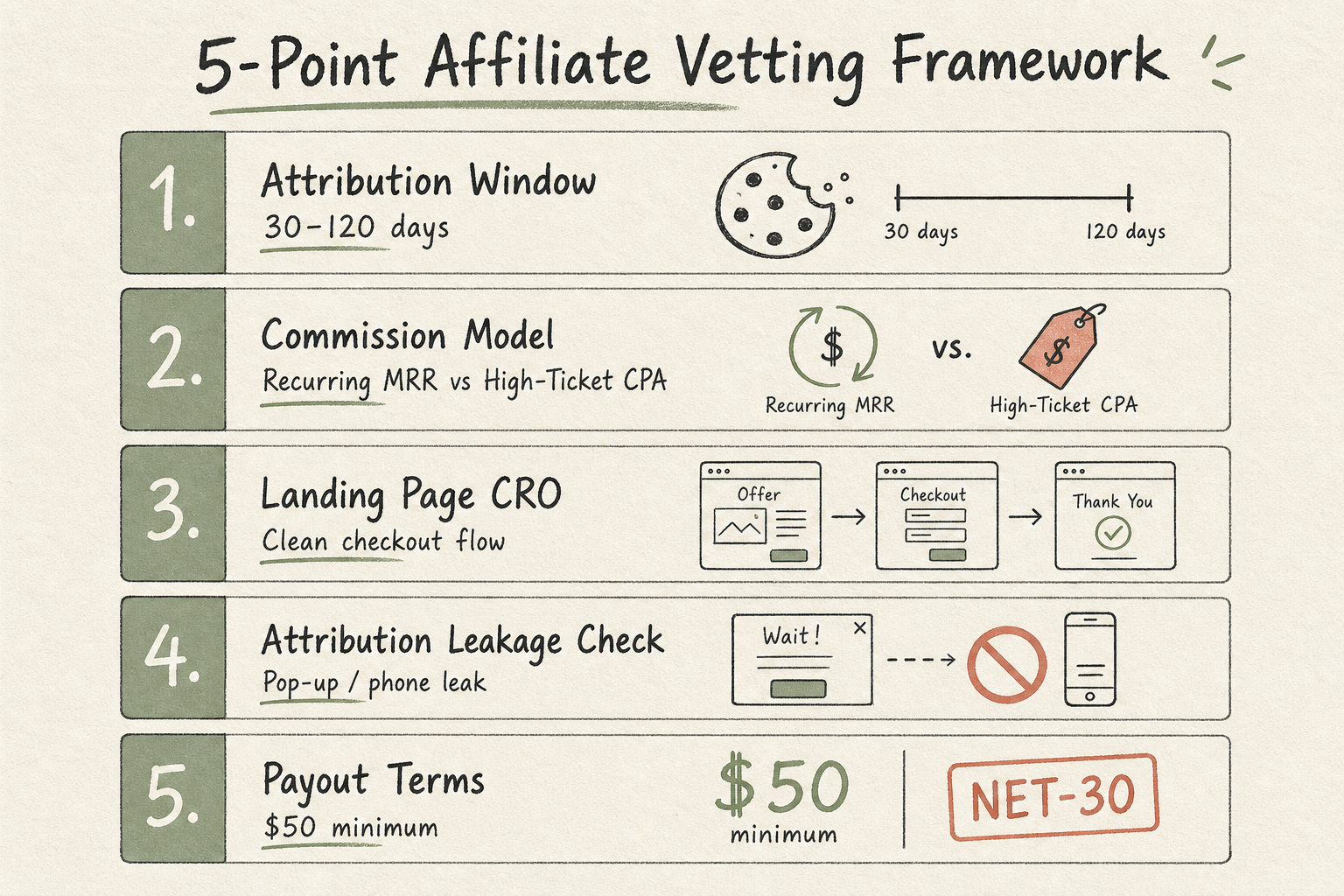
When reviewing a vetted affiliate programs list for digital marketers, use this five-point framework to evaluate every offer.
1. The Cookie Duration (Attribution Window)
The cookie duration determines how long you have to earn a commission after a user clicks your link. In the B2B and SaaS space, purchasing decisions are rarely spontaneous. A user might read your blog post on a Tuesday, sign up for a free trial the following Monday, and finally upgrade to a paid tier a month later.
- Poor: 24 hours to 7 days (Common in low-margin retail, like Amazon Associates).
- Standard: 30 to 45 days.
- Excellent: 60 to 120+ days, or lifetime attribution.
2. Commission Structure: High-Ticket vs. Recurring
Digital marketers generally focus on two highly profitable models.
- Recurring Commissions: You earn a percentage (usually 20% to 30%) of the customer's subscription fee for as long as they remain a customer. This builds compounding passive income.
- High-Ticket CPA: You earn a massive flat fee (e.g., $150 to $500+) for a single conversion.
A $500 one-time payout might look better on paper, but a 30% recurring commission on a $100/month software tool will surpass that flat fee in less than two years—provided the software has low churn.
3. Conversion Rate Optimization (CRO) of the Destination Page
You can drive thousands of highly targeted clicks to a merchant, but if their landing page is poorly designed, loads slowly, or lacks clear pricing, your conversion rate will flatline. Before joining any program, click the affiliate link yourself. Does the page make you want to buy? Is the checkout process seamless? If the merchant hasn't optimized their own sales funnel, they will waste your hard-earned traffic.
4. Leakage and "Stolen" Attribution
Check the merchant's landing page for "leaks." If they heavily push visitors to call a 1-800 number, and phone sales aren't tracked back to your affiliate ID, you are losing money. Similarly, if they offer a massive pop-up discount code right before checkout, and that code overrides your affiliate tracking cookie, you lose the commission. Vetted programs use tracking platforms that respect the affiliate's original referral.
5. Payout Minimums and Terms
Always check the fine print for payout thresholds. Some programs require you to earn $500 before they issue a check, effectively holding your money hostage if you only make a few sales a year. Look for programs with low thresholds ($50 or less) and favorable payout terms like Net-30 (you get paid 30 days after the end of the month the sale occurred).
The Ultimate Vetted Affiliate Programs List for Digital Marketers
Drawing from expert industry analyses and robust database directories, here is a curated list of vetted affiliate programs tailored specifically for digital marketers, content creators, and agencies. We have categorized them by niche so you can effectively match the offer to your audience's intent.
Category 1: Marketing Toolkits & SEO Platforms
Digital marketing audiences are inherently hungry for tools that help them optimize, rank, and convert. Promoting these tools requires technical knowledge, but the payouts are substantial.
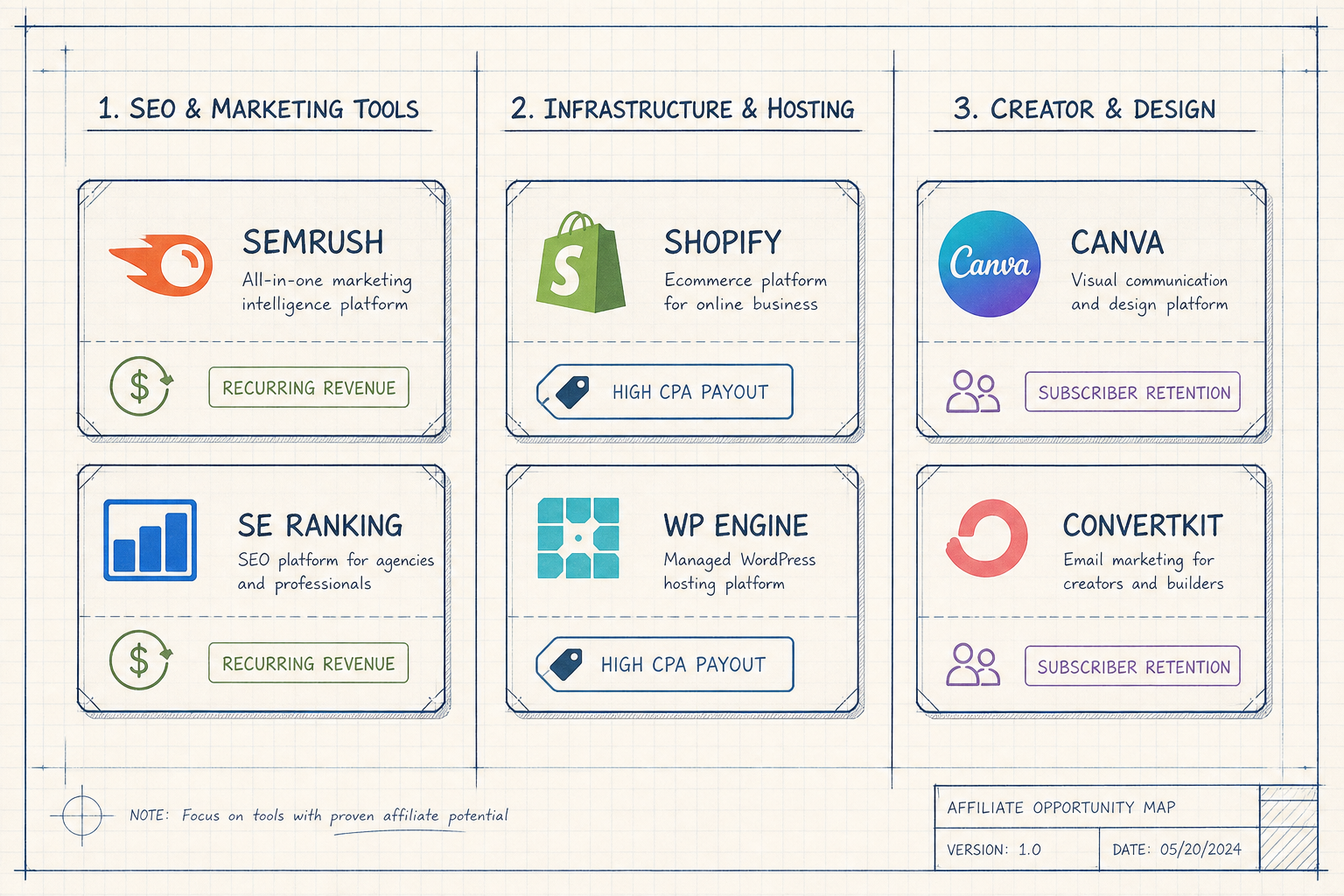
1. SEMrush SEMrush is an industry standard for SEO professionals, content marketers, and PPC specialists. Their affiliate program is widely considered one of the best in the marketing space due to its generous CPA structure.
- Commission: Up to $200 per new subscription sale, plus $10 for every new free trial activation, and $0.01 for new sign-ups.
- Cookie Duration: 120 days.
- Why it's vetted: Paying for free trial activations is rare and highly lucrative. It significantly lowers the barrier to conversion for your audience. A 120-day cookie ensures you get credited even if the agency takes months to finalize their budget.
2. SE Ranking A strong alternative to SEMrush, particularly for budget-conscious marketers and smaller agencies.
- Commission: 30% lifetime recurring commission.
- Cookie Duration: 120 days.
- Why it's vetted: By offering a lifetime recurring commission, SE Ranking allows marketers to build a stable MRR (Monthly Recurring Revenue) baseline. The 120-day cookie is exceptionally generous for the SEO software space.
3. HubSpot HubSpot is a juggernaut in the inbound marketing, CRM, and sales software space. Promoting HubSpot is ideal if your audience consists of founders, sales teams, or agency owners.
- Commission: 30% recurring commission (up to one year) or a 100% flat rate of the first month's revenue.
- Cookie Duration: 90 days.
- Why it's vetted: HubSpot provides a vast library of high-converting creative assets, webinars, and free tools that you can link to, making it much easier to drive initial awareness and eventual conversions.
Category 2: E-Commerce & Website Infrastructure
If you teach people How to Start a Profitable Affiliate Marketing Blog or how to build an online store, website infrastructure is your most dependable monetization channel. According to extensive industry data, digitalmarketingindelhi highlights several high-performing platforms in this exact space.
4. Shopify Shopify is synonymous with e-commerce. Their affiliate program is highly selective but extremely rewarding for educators and influencers in the e-commerce space.
- Commission: Up to $150 for all full-priced plan referrals.
- Cookie Duration: 30 days.
- Why it's vetted: Brand recognition does the heavy lifting. When you recommend Shopify, you rarely have to explain what it is or prove its reliability.
5. BigCommerce BigCommerce caters heavily to enterprise and scaling e-commerce businesses. If your audience outgrows standard platforms, this is the upgrade you recommend.
- Commission: 200% of the customer's first monthly payment, or up to $1,500 for an enterprise referral.
- Cookie Duration: 90 days.
- Why it's vetted: The massive 200% upfront bounty is one of the highest in the e-commerce category. A single conversion can fundamentally alter your revenue for the month, making it a prime candidate for a 11 High Paying Affiliate Programs for $500+ Commissions strategy.
6. WP Engine For WordPress users, WP Engine represents the premium tier of managed hosting. It targets developers, agencies, and serious businesses rather than hobbyist bloggers.
- Commission: $200 minimum per signup, or 100% of the first month's payment (whichever is higher).
- Cookie Duration: 180 days.
- Why it's vetted: The staggering 180-day cookie sets WP Engine apart. Furthermore, they allow you to earn sub-affiliate commissions and offer tiered bonuses if you refer a high volume of customers in a single month.
7. SiteGround SiteGround is consistently recommended in the web hosting space for its balance of performance and affordable pricing.
- Commission: Performance-based scaling. 1-5 sales/mo ($50/sale), 6-10 sales ($75/sale), up to custom rates for 21+ sales.
- Cookie Duration: 60 days.
- Why it's vetted: Unlike legacy hosts with terrible retention, SiteGround boasts excellent customer support, meaning you can confidently recommend it without burning trust with your audience.
Category 3: Design, Creation & Ecosystem Tools
Content creators, social media managers, and freelance designers rely on these tools daily. These programs are characterized by massive global appeal and high conversion rates.
8. Canva Canva has democratized graphic design. Its affiliate program (Canva Pro) is wildly popular because the tool is universally useful across almost every digital niche.
- Commission: Up to 80% on the first month for monthly subscriptions, or 25% on annual subscriptions.
- Cookie Duration: 30 days.
- Why it's vetted: The conversion rate for Canva Pro is exceptionally high. Because millions of users already use the free version, pushing them to upgrade to Pro (for features like background removal and brand kits) is a frictionless sell.
9. ConvertKit ConvertKit is an email marketing platform built specifically for creators, bloggers, and newsletter operators.
- Commission: 30% recurring commission for up to 24 months.
- Cookie Duration: 90 days.
- Why it's vetted: Email marketing software has incredible "stickiness." Once a creator builds their automations and imports their list into ConvertKit, they rarely leave. This results in reliable, long-term recurring revenue.
10. Teachable / Thinkific Online course platforms surged in popularity over the last few years and remain a staple for digital educators.
- Commission: 30% to 50% recurring lifetime commissions (depending on the platform and tier).
- Cookie Duration: 90 days.
- Why it's vetted: Course creators often buy expensive annual plans. A 30% cut of a premium annual plan yields substantial immediate cash flow, alongside the promise of recurring renewals.
Strategic Niches for B2B and SaaS Programs
Knowing which programs to join is only half the battle; knowing where to deploy them is what dictates success. You can't just slap a WP Engine banner on a fitness blog and expect results.
If you want to capitalize on high-paying digital marketing tools, you need to align your content with the 9 Profitable Affiliate Marketing Niches to Start in 2026. Here is how professional marketers match vetted programs to specific audience intents.
1. The "How to Start an Agency" Niche
- Target Audience: Freelancers transitioning to agency models, aspiring entrepreneurs.
- Core Offerings: White-label SEO tools (SE Ranking), CRM software (HubSpot), Invoice and accounting software (FreshBooks).
- Why it works: New agencies require a tech stack to operate. By providing a blueprint of the exact tools they need, you capture high-intent buyers who are ready to invest capital into their new business.
2. The Niche Site & SEO Education Space
- Target Audience: Bloggers, niche site builders, affiliate marketers.
- Core Offerings: Premium hosting (WP Engine), keyword research tools (SEMrush), theme builders.
- Why it works: This is a highly educated audience. They don't want generic advice; they want data-backed case studies. If you can prove that a specific tool increased your organic traffic by 40%, they will click your affiliate link to replicate your success.
3. The Creator Economy & Monetization Niche
- Target Audience: YouTubers, Instagram influencers, newsletter writers.
- Core Offerings: Course platforms (Teachable), email marketing (ConvertKit), design tools (Canva).
- Why it works: Creators are constantly looking for ways to decouple their income from algorithm-dependent ad revenue. Teaching them how to launch a digital product or a paid newsletter seamlessly integrates these affiliate offers.
If you are struggling to narrow down your focus, read How to Pick a Niche for Affiliate Marketing in 5 Steps to ensure your chosen topic has sufficient commercial viability.
How to Build a Portfolio of Vetted Programs Without Spreading Yourself Thin
A common mistake among newer digital marketers is the "spray and pray" approach. They use a directory like AffiliList, get excited by the transparency, and immediately sign up for 40 different programs. They end up with scattered links, diluted messaging, and zero significant payouts.
To build an Affiliate Marketing Side Hustle: 5 Steps to $1k/Mo (2026), you need a disciplined portfolio strategy. Focus on the "Core + Complementary" model.
1. Select One "Core Anchor" Offer
Your core anchor offer should be the most critical tool your audience needs to achieve their primary goal. If you teach e-commerce, your anchor is Shopify. If you teach blogging, your anchor is web hosting.
- Strategy: Dedicate 70% of your promotional effort—your flagship tutorials, your email welcome sequence, your primary resource page—to this single offer.
- Goal: Drive enough volume to negotiate a higher custom commission rate with the merchant.
2. Layer in 3-5 "Complementary" Offers
Complementary offers solve secondary problems that arise after the user purchases the anchor offer.
- Example: A user buys Shopify (Anchor). Now they need a specialized app for product reviews, an email marketing tool to recover abandoned carts (ConvertKit), and a design tool for their social media ads (Canva).
- Strategy: Mention these organically within workflow tutorials. E.g., "How I Set Up My Abandoned Cart Emails in 30 Minutes."
By tightly integrating a small, vetted cluster of tools, you maximize the lifetime value of every reader who enters your ecosystem. This prevents choice paralysis and establishes you as a trusted curator rather than a desperate salesperson. Expert resources like backlinko emphasize that stopping the guesswork and focusing on the best fit for your specific industry is the fastest path to earning.
Advanced Promotion Channels for Digital Marketing Offers
Once you have secured your links from a vetted list, you need to drive qualified traffic. The days of simply dropping links in Facebook groups are long gone. You need scalable, intent-driven channels.
Organic Search (SEO) via Comparison Content
The highest-converting affiliate content targets bottom-of-the-funnel, transactional keywords. Instead of writing broad guides like "What is Email Marketing?", write hyper-specific comparison posts.
- ConvertKit vs. Mailchimp for Paid Newsletters
- SEMrush vs. Ahrefs: Which is Better for Local SEO Agencies? When a user searches for a "vs" keyword, they already have their credit card out. They simply need you to help them make the final decision.
Leveraging Pinterest for Digital Products
Many digital marketers assume Pinterest is only for recipes and home decor. This is a massive blind spot. Pinterest is a powerful visual search engine heavily utilized by aspiring entrepreneurs, bloggers, and small business owners looking for templates, checklists, and software recommendations.
Creating highly visual pins that link to your software reviews or resource lists can drive compounding, long-term traffic. For a complete breakdown on this underutilized channel, explore our Step-by-Step: Setting Up Affiliate Marketing on Pinterest guide.
The Dedicated "Stack" or "Resources" Page
Every digital marketer should have a dedicated /tools or /resources page on their website. This is a curated list of exactly what you use to run your business. Do not list 50 tools here. List the 10 you actually use, explain exactly why you use them, and include your affiliate links. This page often becomes one of the most visited and highest-converting pages on a site because it acts as a trusted, behind-the-scenes look at your operations.
Common Traps in "High-Paying" Affiliate Offers
When browsing a vetted affiliate programs list for digital marketers, it is easy to get blinded by the numbers. Here are three traps to avoid.
Trap 1: The "100% Commission" Mirage You will occasionally find digital products promising 100% commissions. How is this possible? The merchant is using the front-end product as a loss leader. They give you the entire $10 front-end sale just to acquire the customer, and then they aggressively upsell them on a $2,000 backend coaching program—which you get zero commission on. Always read the terms on upsell attribution.
Trap 2: Brand Bidding Restrictions Many high-paying SaaS programs have strict rules against PPC (Pay-Per-Click) brand bidding. This means you cannot run Google Ads targeting keywords like "Buy SEMrush" or "Shopify Coupon." If you violate this policy, the merchant will reverse your commissions and ban you from the program. Always verify the PPC policy before spending money on ads.
Trap 3: The "Minimum Payout" Hostage Situation We touched on this earlier, but it bears repeating. A program that pays $10 per lead but requires a $500 minimum threshold before paying out is hoping you abandon your account at $490. Always prioritize platforms with fair, attainable payout minimums. Top authorities evaluating the field, such as getresponse, consistently highlight platforms that prioritize partner success and clear payout terms.
FAQs on Vetted Affiliate Programs
What is the most profitable niche for digital marketers? In terms of raw payout, SaaS (Software as a Service) and financial technology (FinTech) are highly lucrative because the lifetime value of a customer is massive. Software companies have high margins and can afford to pay aggressive CPA rates or long-term recurring revenue. To explore this deeper, review the 7 Most Profitable Affiliate Marketing Niches to Target.
Do I need a large audience to get accepted into premium, vetted programs? Not necessarily. While some exclusive programs require minimum traffic thresholds, many high-ticket SaaS programs care more about the quality and relevance of your audience. If you have a highly targeted email list of 500 agency owners, a merchant will prefer you over a meme account with 50,000 followers. Having a professional, well-designed website that clearly outlines your content strategy is usually enough to get approved.
How do I track my clicks and conversions efficiently? If you use a directory like AffiliList to discover programs, you will ultimately be linking out via different merchant platforms (Impact, PartnerStack, in-house). To manage this, use a link cloaking and tracking tool like ThirstyAffiliates or Pretty Links on WordPress. This allows you to create clean URLs (e.g., yourdomain.com/go/semrush), track clicks internally, and quickly update the destination URL in one place if the merchant ever changes their tracking system.
Are there full-time roles focused entirely on affiliate management? Yes. As brands recognize the power of partner marketing, there is a massive surge in demand for in-house affiliate managers. These professionals vet affiliates, negotiate rates, and optimize the merchant's program. If you are interested in the corporate side of this industry, check out Who is Hiring? 9 Affiliate Marketing Jobs for 2026.
Moving Forward Without the Clutter
The era of blindly applying to legacy networks and hoping for the best is over. Digital marketers require speed, transparency, and data to build profitable revenue streams. By utilizing open directories that provide a vetted affiliate programs list for digital marketers, you can bypass the gatekeepers, analyze the actual commission structures upfront, and integrate the best SaaS and digital tools directly into your content strategy.
Focus on strict vetting criteria—cookie duration, conversion rates, and recurring potential. Choose a core anchor offer, complement it with secondary tools, and build high-intent content that naturally drives your audience toward a purchasing decision. The opportunities in the digital marketing niche are vast, provided you partner with programs that actually value the traffic you bring to the table.