
Shareasale Alternatives for Affiliate Program Finder for SAAS Lists
Discover top ShareASale alternatives and specialized SaaS affiliate program finders to source high-paying, recurring commission B2B software offers.

- Why Legacy Networks Struggle with SaaS Program Discovery
- Top Open Directories and SaaS Program Finders
- Dedicated SaaS Networks and Partner Infrastructure Platforms
- Evaluation Criteria: How to Judge a SaaS Program Finder
- Case Scenario: Transitioning from Retail Networks to SaaS Lists
- Red Flags and Pitfalls When Sourcing SaaS Offers
- Step-by-Step System: Sourcing and Securing Your First 5 SaaS Offers
- Aligning SaaS Affiliate Offers with Promotional Channels
- Frequently Asked Questions
- What makes SaaS affiliate programs more profitable than traditional e-commerce offers?
- Why do many SaaS companies avoid listing on ShareASale or CJ Affiliate?
- How do I know if a SaaS program directory listing is up to date?
- Can I promote SaaS affiliate offers without an established B2B website?
- What is the typical cookie duration for a SaaS affiliate offer?
- Final Strategic Summary
Traditional affiliate networks were designed during the early e-commerce expansion to connect publishers with physical product brands. If you built a website reviewing consumer electronics, footwear, or home goods, platforms like ShareASale, CJ Affiliate, or Awin provided a centralized marketplace to search for merchants. You applied to the network, waited for approval, browsed vendor listings, and built trackable links that paid a one-off commission when a user completed a transaction.
When you attempt to use those same legacy networks to build a portfolio of Software as a Service (SaaS) products, the model breaks down. Most B2B software companies, digital tool creators, and cloud platforms do not list their programs on legacy retail marketplaces. SaaS monetization relies on monthly recurring revenue (MRR), multi-tiered pricing, extended free trial conversions, and high customer lifetime value (LTV). Relying on traditional marketplaces often leads to incomplete databases, outdated payout terms, and gated sign-up flows that hide basic commission details until you complete a lengthy application process.
If you are looking for dedicated directories, specialized program finders, and SaaS-first networks to source high-converting software offers, modern alternatives exist. This guide analyzes the best directories and marketplaces for discovering SaaS affiliate lists, contrasts open search databases with managed partner networks, and provides a framework for evaluating payout stability.
Why Legacy Networks Struggle with SaaS Program Discovery
Legacy networks like ShareASale built their operational structures around transaction-based e-commerce. Physical goods carry thin profit margins, short attribution windows, and single-event payouts. Software companies operate under entirely different unit economics, which makes legacy marketplaces poorly suited for software affiliate discovery.
+-----------------------------------------------------------------------+
|                       THE DISCOVERY GAP IN SAAS                       |
+-----------------------------------------------------------------------+
| LEGACY NETWORKS (ShareASale/CJ)   | MODERN SAAS FINDERS (AffiliList)   |
|-----------------------------------+-----------------------------------|
| * Gated login required to view    | * Open access to commission terms |
| * Heavy focus on 5-10% flat CPAs  | * Focus on 20-40% recurring MRR   |
| * E-commerce & physical goods     | * Specialized software categories |
| * High rates of broken links      | * Verified actively-managed links |

+-----------------------------------------------------------------------+
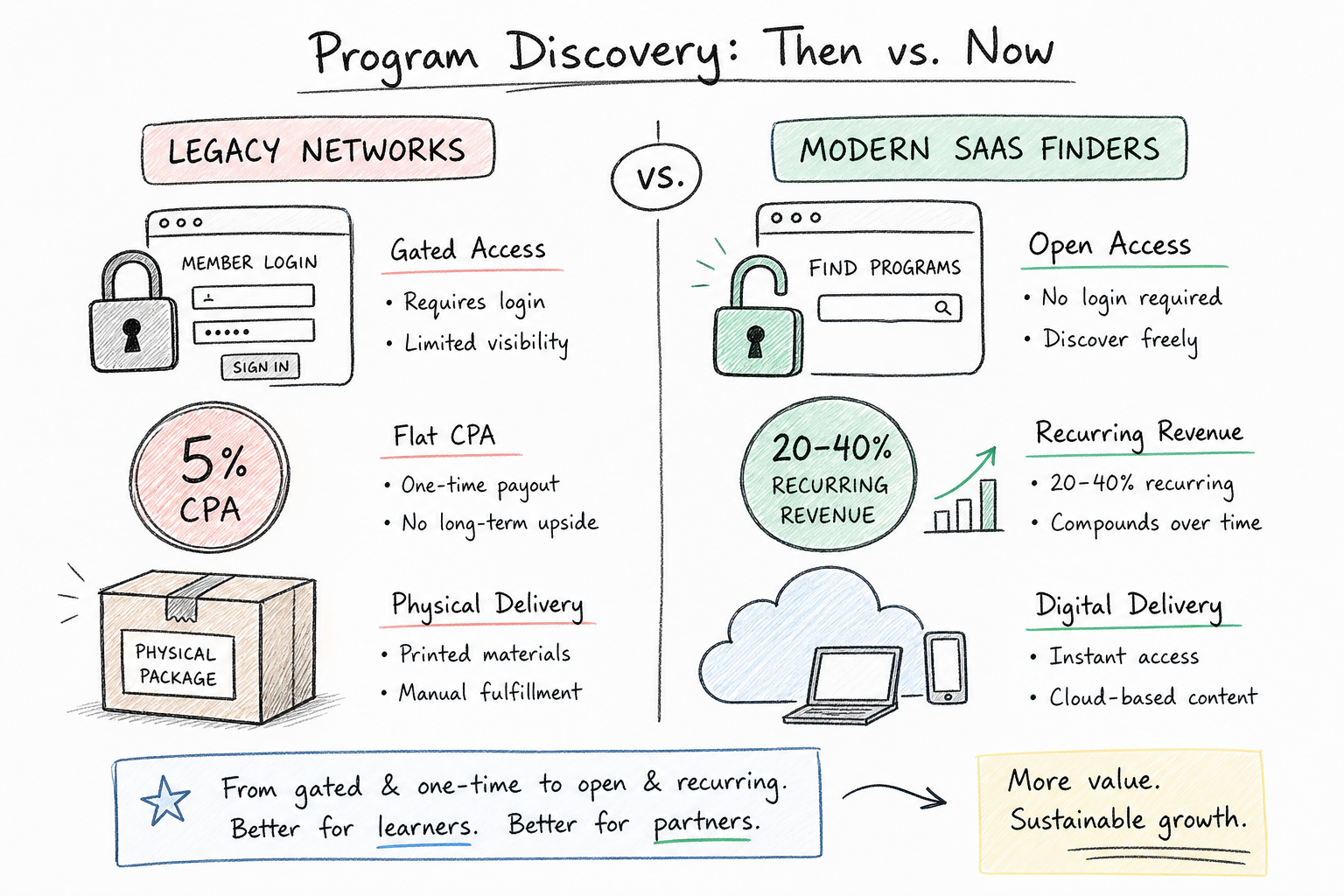 Understanding these limitations helps explain why top software vendors choose dedicated SaaS directories or independent tracking platforms over traditional affiliate networks:
1. Gated Access vs. Open Transparency
Traditional networks force publishers to create a full account, submit tax documents, and wait for manual approval before showing detailed merchant terms. If a creator wants to benchmark commission rates across five rival email marketing tools before writing a comparison review, legacy platforms require applying to each merchant individually. Modern SaaS program finders offer public access to commission percentages, cookie durations, and payment schedules without requiring an account upfront.
2. One-Off CPAs vs. Recurring Revenue Structures
Physical products pay a single Cost Per Acquisition (CPA), usually ranging between 3% and 10%. SaaS merchants frequently offer 20% to 40% recurring monthly payouts for the lifetime of the customer account, or flat payouts exceeding $100 per trial conversion. Traditional network interfaces struggle to standardise and display these recurring, multi-tiered payout mechanics accurately, making compensation models difficult to compare at a glance.
3. Outdated Directory Maintenance
Maintaining an active affiliate directory requires continuous verification. Legacy network directories often contain merchant accounts that have been inactive for years, leading to broken sign-up links, unmonitored tracking scripts, and delayed payouts. Specialized SaaS program finders focus on continuous database hygiene, removing dead links and flagging programs with updated terms.
4. Poor Categorization for Digital Tools
Finding niche software on a general retail network is notoriously difficult. Categories like "Services" or "Business" lump enterprise cloud infrastructure together with local printing services or office supplies. Dedicated SaaS list finders organize programs by precise software sub-niches, such as AI writing assistants, developer APIs, HR automation, workflow tools, and SEO suites.
Top Open Directories and SaaS Program Finders
For affiliate marketers, content creators, and site owners who want fast, un-gated access to curated software listings, open directories offer the most efficient starting point. These platforms do not require network approvals simply to research potential software partners.
| Platform | Category Focus | Access Model | Primary Strengths | Best Used For |
|---|---|---|---|---|
| AffiliList | SaaS & Digital Tools | Open Access (No Sign-Up) | 10,000+ listings, granular tagging, clear payout metrics | Fast research, software comparison, niche sourcing |
| SaaSHub | General Software Marketplace | Open Directory | Product discovery with affiliate indicators | Identifying software alternatives with partner offers |
| SaaSAffiliate.com | B2B Software | Open / Directory List | Search by payment structure (Recurring vs. CPA) | Sourcing recurring revenue B2B offers |
| AffiliatePrograms.com | Multi-Niche | Open Directory | Broad niche coverage with software section | General directory browsing across multiple verticals |
1. AffiliList
AffiliList is a streamlined directory built specifically to solve the transparency issues of legacy networks. Housing a curated database of over 10,000 affiliate programs with a major emphasis on SaaS and digital tools, it eliminates the need to sign up for accounts just to view commission structures.
Marketers can browse software programs across detailed verticals including developer tools, YouTube marketing, crypto, HR systems, and productivity suites. The platform features an advanced tagging system and specific filters for commission structures, allowing users to instantly separate recurring monthly programs from one-time CPA offers. Because the database is updated continuously, creators avoid dead links and outdated tracking policies, making it a reliable hub when building out content for an affiliate marketing blog.
2. SaaSHub
While primarily structured as a software discovery platform and product alternative network, SaaSHub tracks thousands of active cloud tools. Each listing includes metadata about the software, user reviews, tech stack tags, and an indicator showing whether the vendor maintains an active affiliate or referral program.
SaaSHub is particularly useful when conducting competitive analysis. If you are reviewing a well-known software tool that does not offer a partnership program, you can search SaaSHub for direct product alternatives and filter for competing tools that do pay commissions.
3. SaaSAffiliate.com
SaaSAffiliate is an open database focused exclusively on B2B software listings. Its main advantage is its specialized filtering mechanism, which allows users to query programs based on payment type—such as flat lead commissions, tier-1 user acquisition payouts, or lifetime monthly recurring shares.
It provides a clean overview of base commission rates, cookie lengths, and payment processors used by the vendor, though its total program inventory is smaller than broader specialized directories.
4. AffiliatePrograms.com
AffiliatePrograms.com functions as a general directory covering diverse industries, but it maintains a dedicated, regularly updated B2B and SaaS section. It provides high-level program summaries, listing average conversion windows, merchant approval requirements, and estimated payout tiers. It works well as a supplementary tool for cross-referencing listings across broader verticals.
Dedicated SaaS Networks and Partner Infrastructure Platforms
Open directories are ideal for research and discovery. However, when you are ready to apply, grab tracking links, and manage payouts, SaaS companies typically host their programs on specialized partner management infrastructure rather than traditional retail networks.
Understanding where SaaS vendors run their programs helps you streamline your operational workflow. When evaluating best niches for affiliate marketing, knowing these primary backend networks is essential.
+-----------------------------------------------------------------------+
|                    SAAS DIRECTORY VS NETWORK WORKFLOW                 |
+-----------------------------------------------------------------------+
|                                                                       |
|   [ Discovery Phase ]  --->  Open Directories (AffiliList / SaaSHub)  |
|                               * Compare Commission Terms              |
|                               * Check Cookie Duration                 |
|                               * Filter Recurring vs CPA               |
|                                                                       |
|                                         |                             |
|                                         v                             |
|                                                                       |
|   [ Execution Phase ]  --->  SaaS Networks (PartnerStack / Impact)   |
|                               * Submit Application                    |
|                               * Generate Unique Trackers              |
|                               * Collect Monthly Payouts               |
|                                                                       |

+-----------------------------------------------------------------------+
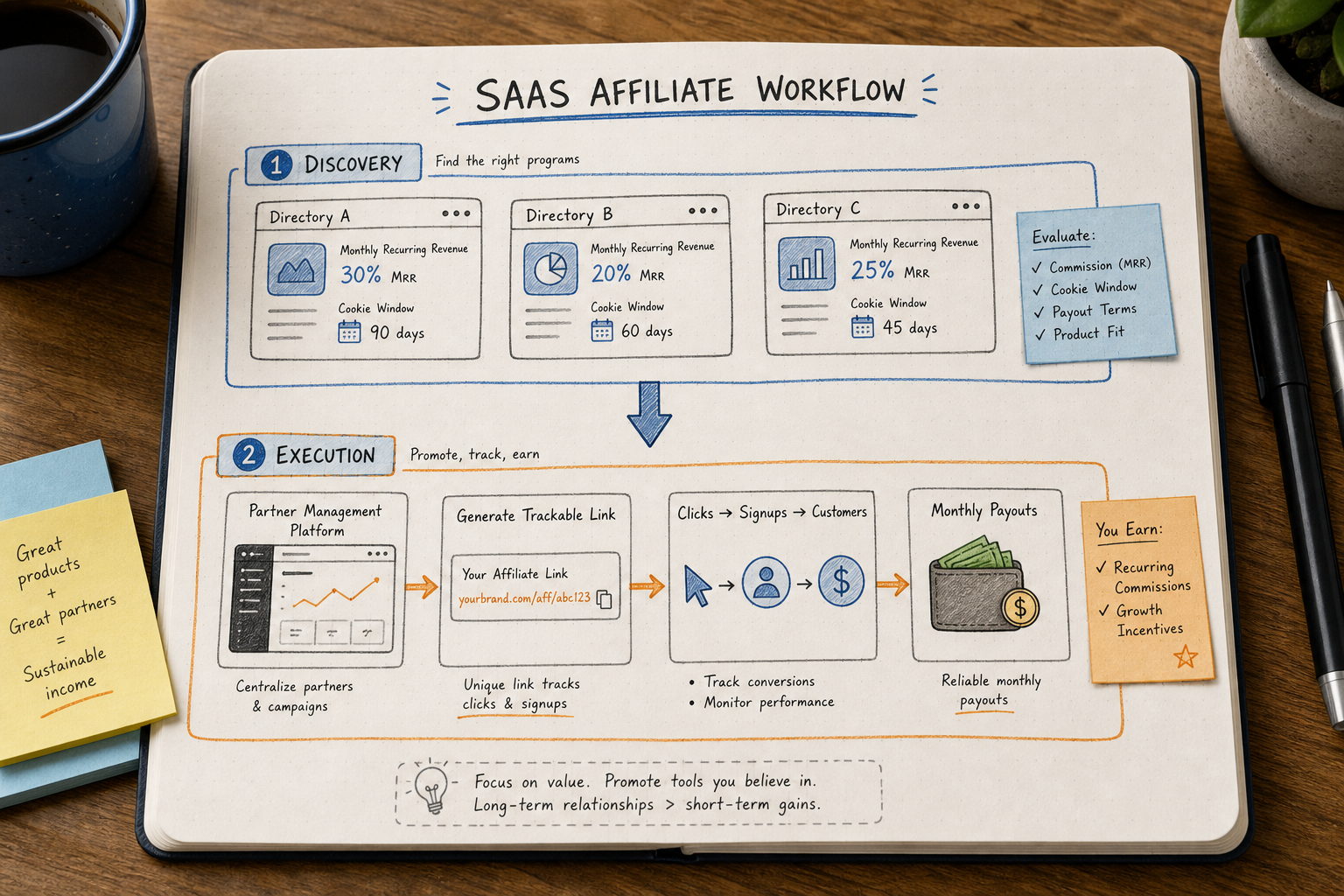
PartnerStack
PartnerStack has emerged as a widely used platform dedicated entirely to B2B software partner programs. Unlike ShareASale, which spans consumer goods, clothing, and retail, PartnerStack hosts software companies such as Monday.com, Notion, Gorgias, and Webflow.
- Key Advantage: A single unified dashboard manages links, analytics, and payouts across dozens of distinct SaaS vendors.
- Payout Reliability: Handles automated payouts via PayPal or Stripe, eliminating the need to send individual invoices to dozens of separate software vendors.
- Discovery Marketplace: Includes an internal marketplace where approved publishers can request access to new B2B programs with a single click.
Impact (Impact Radius)
Impact is an enterprise-level partnership management platform used by mid-market and enterprise software providers, including Canva, Adobe, and BigCommerce.
- Key Advantage: Advanced cross-device tracking, custom contract terms, and flexible attribution rules.
- Payout Reliability: Highly reliable payout processing with custom payout thresholds and automated invoicing.
- Consideration: Enterprise SaaS brands on Impact often enforce strict traffic requirements before approving new publisher applications.
Self-Hosted Platforms (FirstPromoter and Rewardful)
Many high-growth bootstrapped SaaS companies do not join large public affiliate networks. Instead, they run their programs directly on their own websites using dedicated SaaS infrastructure like FirstPromoter or Rewardful.
- FirstPromoter: Popular among developer tools, AI startups, and micro-SaaS platforms. It integrates directly with Stripe to track subscriptions, upgrades, downgrades, and churn automatically.
- Rewardful: Heavily utilized by Stripe-powered SaaS tools. It allows software creators to set up affiliate programs in minutes, offering affiliates direct access to a minimal, clean dashboard showing active referrals and recurring MRR earnings.
Because self-hosted programs powered by FirstPromoter or Rewardful do not have a central public marketplace, open directories like AffiliList are critical for discovering these unlisted opportunities.
Evaluation Criteria: How to Judge a SaaS Program Finder
Not all affiliate program listings are created equal. Sourcing programs from poor directories can result in lost tracking, non-payment, or wasted promotion effort on dead software tools. When evaluating program finders or individual software listings, apply these core metrics:
+-----------------------------------------------------------------------+
|                      PROGRAM EVALUATION MATRIX                        |
+-----------------------------------------------------------------------+
| CRITERIA             | IDEAL BENCHMARK        | RED FLAG              |
|----------------------+------------------------+-----------------------|
| Commission Structure | 20% - 40% Recurring    | One-off $5 flat CPA   |
| Cookie Window        | 60 - 90 Days           | Under 14 Days         |
| Attribution Model    | First or Last Touch    | Ambiguous/Unstated    |
| Program Hosting      | Recognized Stack       | Manual Email Payouts  |
| Directory Data       | Updated within 30 days | Dead vendor links     |

+-----------------------------------------------------------------------+
1. Data Freshness and Link Integrity
A quality program finder must maintain active link verification. Software startups frequently pivot, change ownership, update affiliate management platforms, or shut down entirely. A directory that lists broken signup forms or outdated commission percentages wastes time. Check whether the directory clearly updates its database records and verifies tracking endpoints.
2. Transparency of Payout Terms
Before applying to a program, you should be able to answer four questions instantly:
- Is the commission a flat single payout or a recurring percentage?
- If recurring, how many months does the payout last (e.g., 12 months vs. customer lifetime)?
- What is the cookie attribution window (e.g., 30, 60, or 90 days)?
- What is the minimum payout threshold and payment schedule?
Directories that hide these details behind mandatory registrations slow down research and obscure essential deal terms.
3. Niche Granularity and Search Taxonomy
A basic search bar is insufficient when managing thousands of software titles. Effective program finders categorize tools by operational function (e.g., CRM, Cold Email, Video Editing) and by targeted audience (e.g., Freelancers, Enterprise, E-commerce sellers). This allows creators working in specific verticals to locate relevant software combinations quickly. Finding these aligned tools is a core part of building a successful affiliate marketing side hustle.
4. Direct Vendor Access
The finder should link directly to the merchant’s official affiliate landing page or network portal. Avoid services that act as unauthorized middleman sub-affiliate networks without clear disclosure, as this adds counterparty risk and splits commissions.
Case Scenario: Transitioning from Retail Networks to SaaS Lists
To understand the practical impact of moving from traditional marketplaces like ShareASale to specialized SaaS directories, consider this realistic operational scenario.
The Background
Marcus ran a tech review blog focusing on hardware, home office setups, and productivity tools. His primary monetization strategy relied on ShareASale and traditional retail networks, earning a 4% to 6% single-payment commission on monitors, keyboards, and ergonomic desks.
The Challenge
Despite generating 45,000 monthly visits, his revenue fluctuated wildly based on seasonal buying trends. A user buying a $300 desk earned Marcus a single $15 payout. Once the transaction completed, that user generated zero long-term value for the site.
+-----------------------------------------------------------------------+
|                   REVENUE MODEL TRANSITION SCENARIO                   |
+-----------------------------------------------------------------------+
|                                                                       |
|  SCENARIO A: Retail Hardware (ShareASale)                             |
|  100 Conversions x $200 Desk Sale x 5% CPA = $1,000 (One-Time)        |
|  Month 2 Revenue from same users = $0                                 |
|                                                                       |
|  SCENARIO B: B2B SaaS Tool (AffiliList Sourced)                       |
|  100 Conversions x $50/mo Software x 30% MRR = $1,500 (Month 1)       |
|  Month 2 Revenue from same users = $1,350 (Accounting for 10% Churn)  |
|  Month 3 Cumulative Revenue = $2,715 (Adding new acquisitions)        |
|                                                                       |

+-----------------------------------------------------------------------+
The Transition Strategy
Marcus decided to shift 40% of his content strategy toward workflow automation and software stacks. Instead of searching retail marketplaces, he used open SaaS directories like AffiliList to identify high-converting software tools in the project management and document automation niches.
- Filtering for High-Yield Terms: He searched for B2B software offering at least 30% monthly recurring commissions with a 60-day cookie window.
- Identifying Unlisted Programs: Through directory searches, he discovered three fast-growing software tools running self-hosted programs on FirstPromoter that were completely unlisted on traditional retail networks.
- Restructuring Content: He published detailed workflow guides showing readers how to integrate these software tools to automate remote work setups.
The Results
- Month 1: Sourced 28 recurring subscriptions at an average software price of $60/month (30% recurring payout = $18 per user/month). Initial monthly payout: $504.
- Month 6: Through continuous compounding acquisitions and steady retention, his active recurring subscriber base grew to 310 active seats.
- Financial Impact: Generated $5,580 per month in recurring affiliate revenue from past content, creating a stable floor that remained constant regardless of seasonal hardware sales fluctuations.
This scenario highlights why marketers looking for sustainable income models move away from legacy retail directories toward curated SaaS databases. Finding the right offers is essential when targeting profitable affiliate marketing niches.
Red Flags and Pitfalls When Sourcing SaaS Offers
While SaaS affiliate marketing offers strong earnings potential, evaluating vendor programs requires careful review. Promising high payouts mean little if the software vendor experiences high customer churn or fails to maintain tracking scripts properly.
+-----------------------------------------------------------------------+
|                         SAAS PROGRAM RED FLAGS                        |
+-----------------------------------------------------------------------+
| [!] Unrealistic Payout Claims (e.g., 80% Lifetime on $10/mo product)  |
| [!] Absence of Dedicated Affiliate Manager or Support Channel          |
| [!] Self-Hosted Platforms with No Third-Party Audit Tracking          |
| [!] High Unmanaged Customer Churn Rate (>15% Monthly Churn)          |
| [!] Unannounced Changes to Cookie Length or Minimum Payout Thresholds  |

+-----------------------------------------------------------------------+
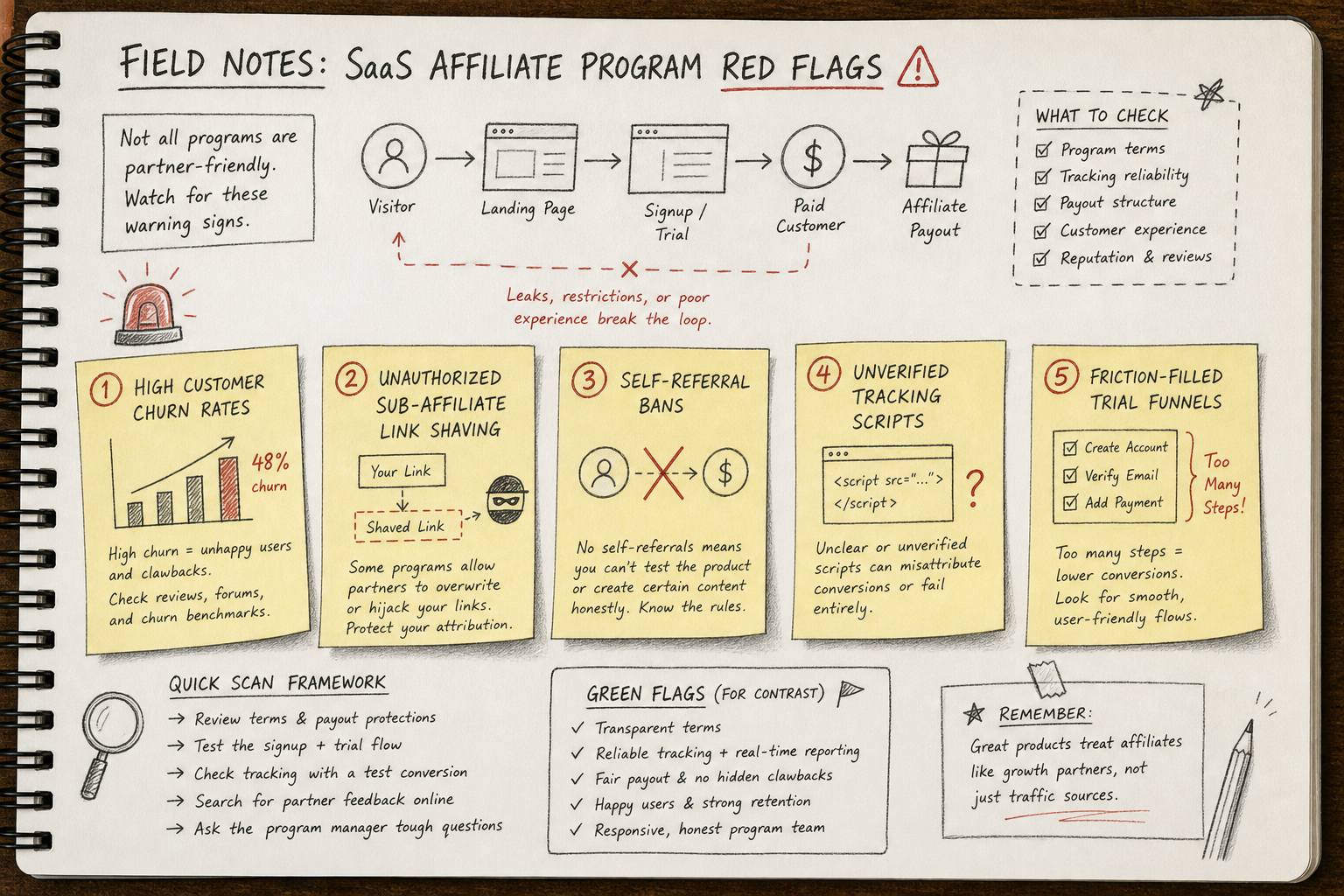
1. The High Churn Phantom
A vendor offering a 50% recurring commission sounds lucrative, but if the software application is buggy, poorly documented, or unsupported, users will cancel after their first month.
- The Math: A 50% recurring payout on a $20 product where users churn after 30 days yields $10 total per customer. A 20% recurring payout on a high-retention $200 enterprise tool where users stay for 24 months yields $960 total per customer.
- Vetting Tip: Test the software yourself before promoting it. Ensure the onboarding process is smooth, customer support is responsive, and core features function reliably.
2. Sub-Affiliate Network Shaving
Be cautious of obscure third-party directories that act as unauthorized intermediaries between you and the primary network. These entities wrap the original referral link inside their own tracking layer, taking a 10% to 30% cut of your earned commission. Always verify that program finders direct you to the merchant’s official portal or a recognized infrastructure provider like PartnerStack, Impact, FirstPromoter, or Rewardful.
3. Unclear Attribution and Self-Referral Rules
Review the fine print regarding cookie attribution models:
- First-Touch vs. Last-Touch: Last-touch attribution rewards the final link clicked before purchase. First-touch rewards the publisher who introduced the customer. Ensure you know which system is active.
- Self-Referrals: Nearly all SaaS programs strictly ban purchasing software through your own referral link. Violating this rule can result in immediate account termination and forfeited balances.
4. Poor Conversion Funnel Architecture
Even if a software product provides high utility, an unoptimized pricing page or a confusing checkout process will hurt your conversions. Before committing premium placement on your site, click through the vendor's acquisition funnel. If free trial sign-ups require extensive friction, or if credit card input fields trigger browser security warnings, your traffic will not convert efficiently. Verifying these metrics ensures you spend time on high paying affiliate programs that actually convert traffic into revenue.
Step-by-Step System: Sourcing and Securing Your First 5 SaaS Offers
To build a high-yielding SaaS portfolio without wasting hours browsing irrelevant listings, follow this structured six-step workflow:
+-----------------------------------------------------------------------+
|                    SAAS SOURCING WORKFLOW STEPS                       |
+-----------------------------------------------------------------------+
|                                                                       |
|  STEP 1: Define Target Niche & User Search Intent                     |
|     |                                                                 |
|  STEP 2: Search Open SaaS Directory (AffiliList)                      |
|     |                                                                 |
|  STEP 3: Filter by Commission Rules (>20% Recurring / 60-Day Cookie)  |
|     |                                                                 |
|  STEP 4: Audit Software Product Quality & Funnel Friction             |
|     |                                                                 |
|  STEP 5: Submit Direct Application via Host Platform                  |
|     |                                                                 |
|  STEP 6: Deploy Tracked Custom Recommendations                        |
|                                                                       |

+-----------------------------------------------------------------------+
Step 1: Define Target Niche and Stack Intent
Identify the specific operational problems your audience faces. Avoid broad categories like "business tools." Instead, isolate specific workflows, such as "automated scheduling for real estate agents" or "invoice tracking for freelance designers." When learning how to pick a niche for affiliate marketing, choosing a clear focus makes offer selection much easier.
Step 2: Query Open Directories
Use open directories like AffiliList to search for relevant software tools without hitting registration walls. Filter listings by your target niche tags and set minimum commission thresholds (e.g., minimum 20% recurring or $50 CPA).
Step 3: Validate Product Health and Market Reputation
Cross-reference your candidate software tools on user review sites like G2, Capterra, or Trustpilot. Ensure the software maintains a rating above 4.0 out of 5 stars and shows active recent product updates. Avoid promoting software with mounting complaints regarding unresolved technical bugs.
Step 4: Inspect the Merchant's Affiliate Infrastructure
Click through the directory listing to inspect the vendor’s primary affiliate sign-up page. Confirm which software powers their tracking (e.g., PartnerStack, Rewardful, FirstPromoter). Read the affiliate agreement terms to verify payout frequency, threshold minimums, and allowed promotional channels.
Step 5: Submit a Tailored Application
When applying to the vendor's program, do not leave application text fields blank. Provide a concise, clear explanation of how you plan to drive traffic:
- State your primary distribution channels (e.g., SEO review site, YouTube channel, specialized newsletter).
- Detail your monthly reach or impression numbers.
- Outline the exact content formats you plan to create (e.g., "A step-by-step tutorial comparing Software X against Software Y").
Step 6: Deploy Tracked Assets and Monitor Attribution
Once approved, generate your unique tracking links and deploy them across your content. Create a internal calendar to check your dashboards every 30 days. Track click-through rates (CTR), trial conversion percentages, and monthly churn metrics to evaluate offer performance over time. Knowing how to verify these tracking flows is vital to confirming that affiliate marketing is legit.
Aligning SaaS Affiliate Offers with Promotional Channels
The way you structure your program searches should align with your primary traffic channels. Different traffic sources convert different types of software pricing models.
+-----------------------------------------------------------------------+
|                   CHANNEL TO OFFER MATCHING MATRIX                    |
+-----------------------------------------------------------------------+
| CHANNEL            | BEST SAAS OFFER TYPE      | PAYOUT PREFERENCE    |
|--------------------+---------------------------+----------------------|
| SEO / Review Sites | Direct Alternative Tools  | High Recurring MRR   |
| YouTube Tutorials  | Workflow Integration Tools| Free-Trial Conversion|
| B2B Newsletters    | High-Ticket Enterprise    | High Flat CPA ($100+)|
| Pinterest & Visual | Design & Content Creation | Low-Friction Monthly |

+-----------------------------------------------------------------------+
1. Organic Search and Comparison Blogs
Search engine traffic often carries high commercial intent. Users searching for "Tool A vs. Tool B" or "Best Alternatives to Tool A" are near the end of their buying decision.
- Strategy: Use open program finders to locate alternatives for market-leading tools that do not pay commissions.
- Best Pricing Model: High monthly recurring programs (20%–40%). Readers looking for long-term operational software generate stable monthly recurring revenue.
- Resource: Learn how to set up an optimized publishing foundation by studying our step-by-step guide on how to start a profitable affiliate marketing blog.
2. Social Media and Visual Discovery (Pinterest & Micro-Video)
Visual platforms perform best when showcasing fast, tangible creative outputs—such as video generation, social media management, image editing, or graphic design tools.
- Strategy: Promote accessible web apps that feature low entry price points or generous free trials.
- Best Pricing Model: Flat CPA payouts on free trial sign-ups or mid-tier recurring options ($10–$30/month).
- Resource: Explore actionable promotion techniques in our guide to setting up affiliate marketing on Pinterest.
3. Email Newsletters and B2B Communities
Email subscribers have a direct, high-trust relationship with the sender. Readers expect curated recommendations that solve professional bottlenecks.
- Strategy: Partner with specialized B2B software vendors that offer higher-tier price points, direct onboarding calls, or customized team demos.
- Best Pricing Model: High-ticket CPA payouts ($100 to $500 per validated team lead) or custom revenue-sharing tiers.
Frequently Asked Questions
What makes SaaS affiliate programs more profitable than traditional e-commerce offers?
SaaS affiliate programs offer superior economics because digital software scale with minimal marginal cost. Unlike physical retail products bound by manufacturing and shipping overhead (yielding 3% to 10% one-time payouts), SaaS companies can offer 20% to 40% monthly recurring commissions or flat CPA payouts over $100. This recurring structure builds compounding monthly income from a single customer referral.
Why do many SaaS companies avoid listing on ShareASale or CJ Affiliate?
Legacy networks were built primarily for e-commerce catalog tracking, physical product SKUs, and single-event transactions. Modern SaaS platforms require direct integration with subscription engines like Stripe, handling mid-cycle plan upgrades, downgrades, churn, and multi-tier recurring payouts. Software vendors prefer hosting their programs on purpose-built partner platforms like PartnerStack, FirstPromoter, or Rewardful, while using open specialized directories like AffiliList for discovery.
How do I know if a SaaS program directory listing is up to date?
Look for directories that offer open, transparent data access, detailed category tagging, and clear verification notes on program terms. Reliable directories verify sign-up endpoints, confirm cookie windows, and separate active recurring programs from flat CPA offers without forcing users through registration paywalls or hidden redirects.
Can I promote SaaS affiliate offers without an established B2B website?
Yes. While a dedicated B2B blog provides strong organic SEO traffic, many SaaS marketers generate referrals through YouTube video tutorials, specialized newsletters, online community tutorials, or active social media funnels. You can explore modern career options in this space by reading our overview of affiliate marketing jobs.
What is the typical cookie duration for a SaaS affiliate offer?
Cookie windows for software programs typically range between 30 and 90 days, with 60 days serving as the industry benchmark for standard B2B tools. Because software purchases—especially enterprise team tools—involve longer decision cycles than low-cost consumer goods, extended cookie windows ensure creators receive proper attribution for delayed purchasing decisions.
Final Strategic Summary
Relying on traditional retail networks like ShareASale to find software affiliate offers limits your exposure to modern cloud tools and recurring income streams. Legacy databases carry high friction, outdated listings, and payment models that fail to capture the recurring unit economics of modern SaaS businesses.
By incorporating dedicated SaaS list finders and open databases into your research workflow, you gain immediate, un-gated visibility into commission structures, cookie windows, and platform integrations. Platforms like AffiliList provide the dataset and filtering tools needed to skip gated networks, cross-reference payout structures, and connect directly with high-converting software vendors.
Whether you are expanding an established content site or launching a new specialized publication, focus your program selection on verified product retention, transparent payout terms, and true recurring structures. For more deep dives into profitable software niches and publisher monetization strategies, browse our complete archive of industry analysis on the AffiliList Blog.