
Best Directory for E-commerce Affiliate Partnerships Tools Beyond Shareasale
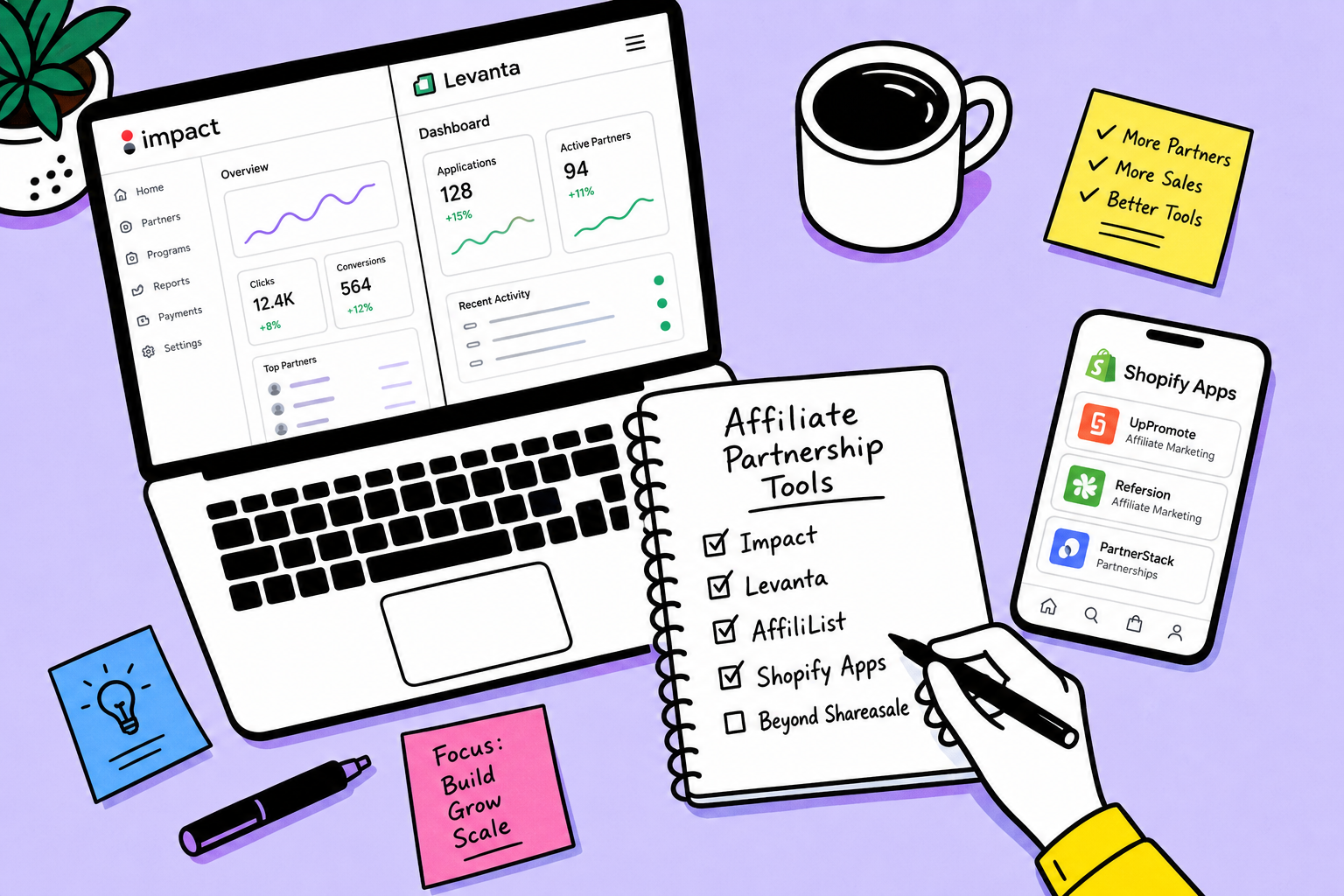
Discover the best directories and tools for e-commerce affiliate partnerships beyond ShareASale, including Impact, AffiliList, Shopify apps, and Levanta.
- The Problem with Legacy Affiliate Networks
- The Best Directories for E-Commerce Affiliate Partnerships
- 1. AffiliList: The Modern Discovery Directory
- 2. Impact: The Modern Enterprise and D2C Standard
- 3. ShareASale: The Independent Retail Hub
- 4. CJ Affiliate: The Enterprise Heavyweight
- 5. ClickBank & Digistore24: Digital E-commerce
- 6. Levanta: The Amazon Seller Alternative
- 7. Awin: The Global Fashion and Retail Leader
- Finding Hidden D2C Programs via App Ecosystems
- Metrics That Matter When Browsing Directories
- The B2B Angle: E-Commerce Infrastructure
- 3 Costly Mistakes When Using E-Commerce Directories
- Adapting for Alternative Traffic Sources
- FAQs About E-Commerce Affiliate Directories
- Strategic Sourcing for Better Margins
If you ask a dozen experienced marketers where to find physical product partnerships, eleven of them will point you to ShareASale. It is the default answer for a reason: the platform has spent over two decades accumulating a massive catalog of independent e-commerce merchants. But logging into legacy networks often feels like stepping back into 2012. You are greeted by a cluttered interface, thousands of dead or inactive programs, and a frustrating barrier to entry where you must apply to a network just to see a brand's commission structure.
For modern affiliate marketers, niche site owners, and content creators, the ecosystem has shifted. Direct-to-consumer (D2C) brands, specialized SaaS e-commerce tools, and digital platforms are migrating away from monolithic networks. They are favoring specialized platforms, in-house software, and transparent directories that do not hide crucial payout data behind a login wall.
Relying solely on ShareASale means missing out on highly profitable, low-competition partnerships. Whether you are promoting enterprise e-commerce software or boutique physical goods, you need specialized directories and discovery tools to find the highest-converting offers.
The Problem with Legacy Affiliate Networks
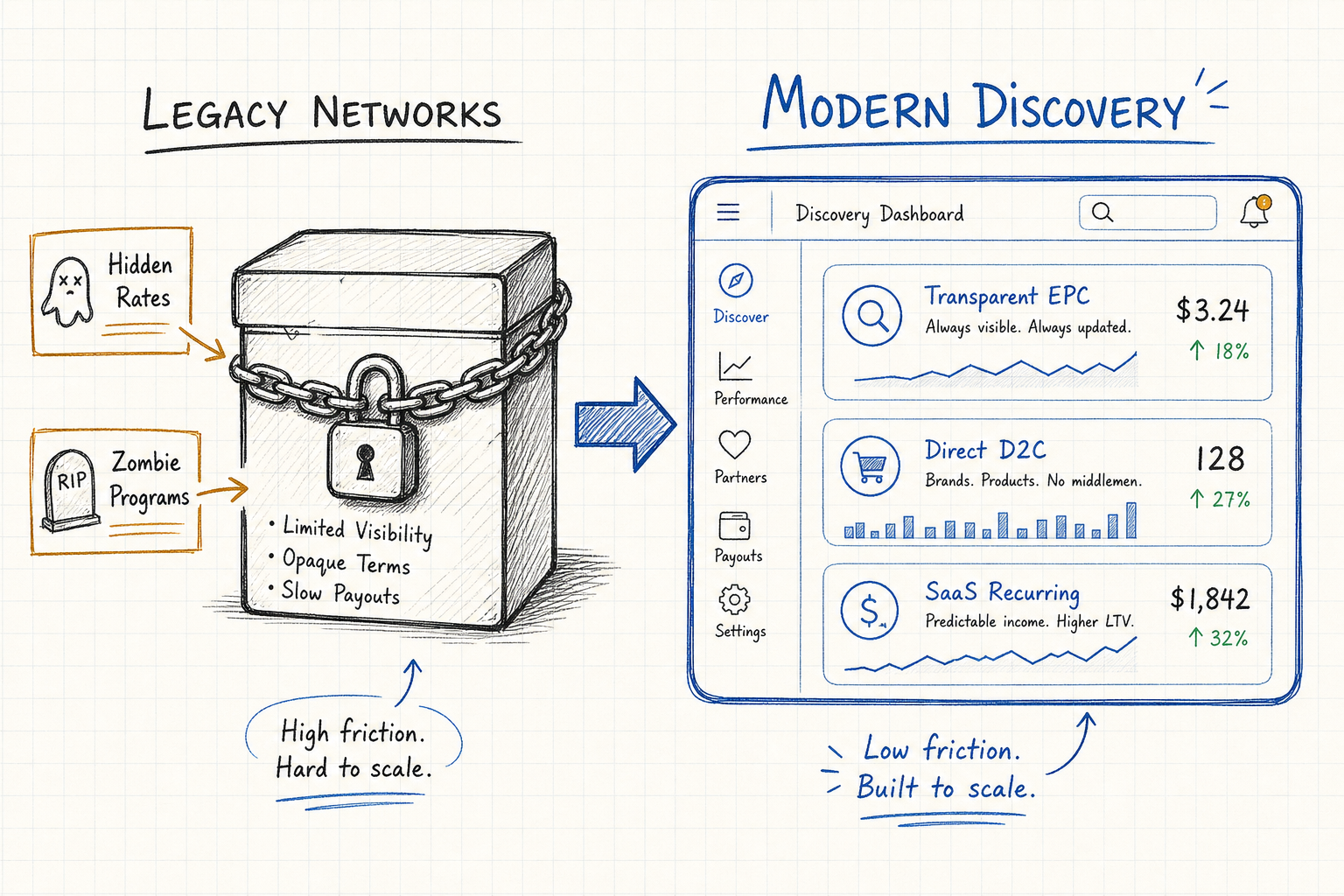
Before looking at the alternatives, it helps to understand why the industry is moving away from a single-network model. Platforms like ShareASale and CJ Affiliate operate as middlemen. They provide the tracking technology, handle the tax compliance, and process the payouts. In exchange, they charge merchants substantial setup fees and ongoing network overrides (a percentage of the affiliate commission).
This model creates several friction points for affiliates searching for partnerships:
- Hidden Data: Most traditional networks require you to apply and be accepted into their ecosystem before you can view granular details about a merchant's commission tiers, cookie durations, or Earnings Per Click (EPC).
- Program Rot: Because legacy networks have been around for decades, their directories are bloated with thousands of zombie programs—merchants who still have active accounts but haven't updated their banners, approved an affiliate, or processed a sale in years.
- The D2C Exodus: Many modern, highly profitable e-commerce brands refuse to pay the hefty network fees of traditional platforms. Instead, they run their programs in-house using Shopify apps or specialized tools. You will never find these brands by searching ShareASale.
To find the best offers, you have to look beyond the closed walls of legacy networks and utilize modern directories, specialized platforms, and community-sourced data.
The Best Directories for E-Commerce Affiliate Partnerships
The landscape of e-commerce affiliate partnerships is broadly split into two categories: discovery directories (platforms built specifically to help you find and compare programs) and tracking networks (platforms that actually host the affiliate links and pay you).
Here are the most effective tools and platforms for finding e-commerce partnerships today.
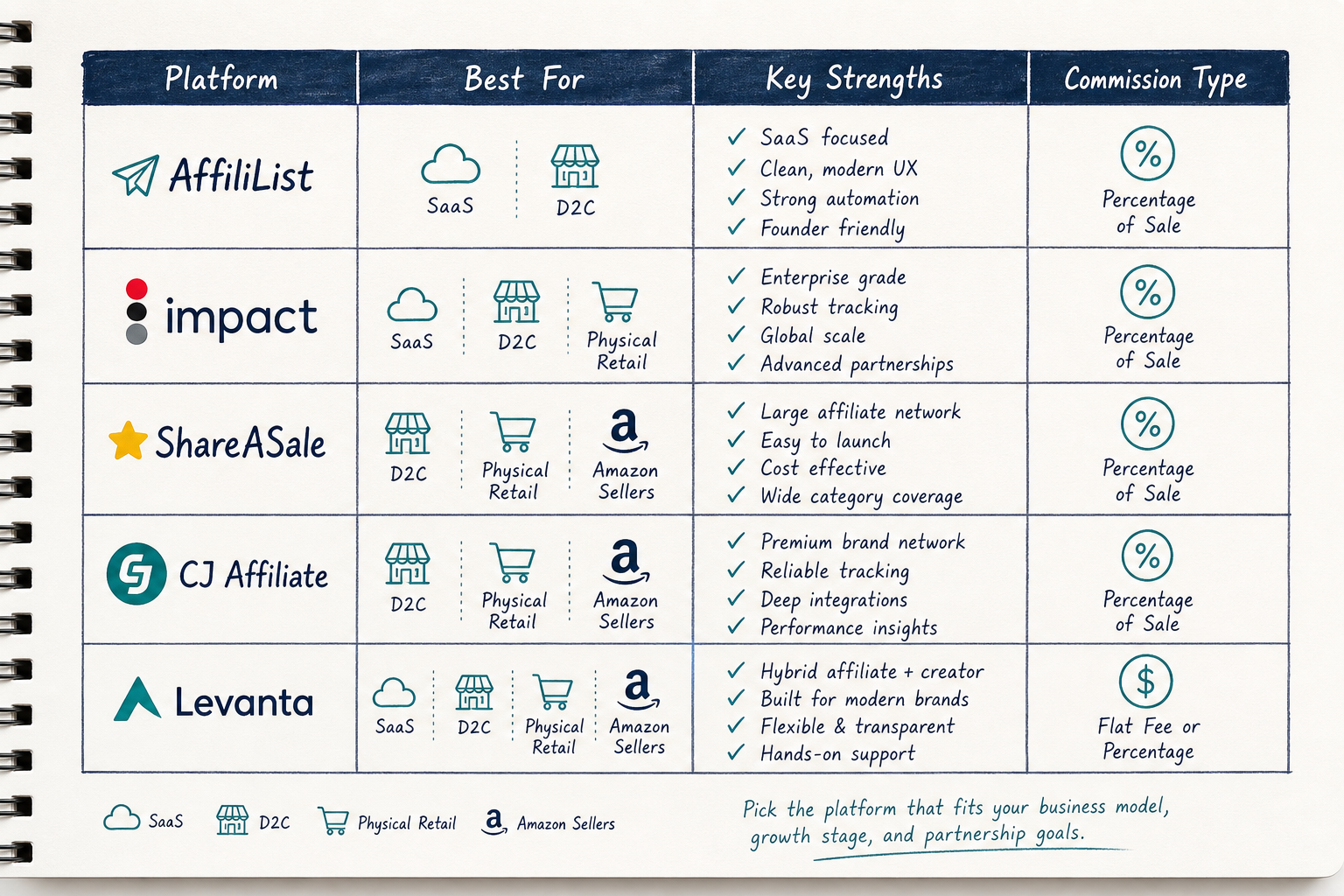
1. AffiliList: The Modern Discovery Directory
If you want to bypass the clunky sign-up processes of traditional networks and instantly compare program data, AffiliList operates as a streamlined, transparent discovery engine. Instead of hosting the tracking links, AffiliList functions as a comprehensive, curated database of over 10,000 affiliate programs, with a particularly strong emphasis on SaaS, digital tools, and e-commerce infrastructure.
The core advantage of AffiliList is transparency. You do not need to create an account on a dozen different tracking platforms just to see what a brand pays. The directory offers open access to program details, including commission percentages, payout types (recurring vs. one-time), and cookie lengths.
For affiliates focused on the B2B side of e-commerce—promoting inventory management software, email marketing tools, or storefront builders to other business owners—AffiliList provides an advanced tagging system and filtering options for commission rates. This makes it incredibly easy to cross-reference opportunities and find 11 High Paying Affiliate Programs for $500+ Commissions without digging through poorly organized network search bars.
2. Impact: The Modern Enterprise and D2C Standard
When major e-commerce brands outgrow basic tracking apps but want a more modern interface than legacy networks, they migrate to Impact (formerly Impact Radius). Impact is a partnership management platform rather than a traditional affiliate network.
Many e-commerce marketers and industry observers consider Impact a preferred platform for major e-commerce brands managing both traditional affiliates and influencers. Because it allows brands to set highly customized, dynamic payout rules based on promo codes, customer location, or specific product SKUs, it has become the go-to choice for premium D2C brands.
Key advantages for affiliates:
- Cross-Device Tracking: Impact handles cookie-less tracking and cross-device attribution better than almost any legacy network, ensuring you get credited when a user clicks on their phone but buys on their desktop.
- Direct Communication: The platform makes it easy to message brand affiliate managers directly to negotiate custom rates or request product samples.
- Influencer Integration: If you leverage platforms like YouTube or Pinterest, Impact is tailored for content creators, not just traditional niche sites.
3. ShareASale: The Independent Retail Hub
Despite its interface flaws, ShareASale cannot be entirely ignored. It remains widely considered the best directory for physical consumer goods, household items, fashion, and boutique D2C brands. Acquired by Awin in 2017, ShareASale is the undisputed heavyweight for independent physical product merchants.
If you are monetizing a home decor blog, a fitness site, or a specialized hobby niche, ShareASale will often have the highest volume of relevant merchants.
How to navigate ShareASale effectively: Ignore the "New Programs" tab, which is often filled with low-converting junk. Instead, heavily utilize the "Power Rank" metric within their directory. Power Rank evaluates a merchant's recent performance on the network, taking into account transaction volume and conversion rates. A brand might offer a generous 30% commission, but if their Power Rank is 3,500, they are likely failing to convert the traffic affiliates send them. Focus on programs in the top 1,000.
4. CJ Affiliate: The Enterprise Heavyweight
CJ Affiliate (formerly Commission Junction) is built for scale. You will rarely find small, independent Shopify stores here. Instead, CJ is the directory for Fortune 500 retailers, major travel aggregators, and massive international e-commerce sites like Barnes & Noble or Overstock.
The reality of working with CJ: The barrier to entry is high. Many enterprise brands on CJ auto-reject applications from newer sites that lack significant traffic volume. Furthermore, CJ has a strict deactivation policy; if you do not generate a commission within a specific timeframe (usually 6 months), your account can be deactivated.
CJ is best utilized once your traffic is established and you are ready to negotiate with household-name retailers who demand strict brand compliance.
5. ClickBank & Digistore24: Digital E-commerce
When marketers hear "e-commerce," they usually think of physical products. But digital e-commerce—selling downloadable software, premium courses, and information products—often yields significantly higher margins.
For affiliates whose focus leans toward digital products, e-books, guides, or health and wellness items, ClickBank remains a powerhouse directory. Because digital products do not require warehousing, shipping, or supply chain management, commission rates frequently hover between 50% and 75%.
Digistore24 has emerged as a strong alternative to ClickBank, particularly for European audiences and high-ticket digital offers. Both directories are completely open, meaning you can browse their marketplaces, grab a tracking link (a "HopLink"), and start promoting immediately without waiting for a manual merchant approval.
6. Levanta: The Amazon Seller Alternative
For years, affiliates promoting physical products had to make a tough choice: use Amazon Associates for unparalleled conversion rates but terrible commissions (often 1% to 3%), or use ShareASale for better commissions but lower conversion rates.
Recently, specialized tools have bridged this gap. Levanta functions as a dedicated affiliate platform designed specifically for Amazon sellers.
Instead of joining Amazon Associates, you use Levanta to partner directly with third-party Amazon brands. These brands want to drive external traffic to their Amazon listings to boost their organic search rankings on the marketplace. Because external traffic is incredibly valuable to them, they are willing to pay standard affiliate commissions (10% to 20%) while still allowing you to send traffic to the highly trusted Amazon checkout ecosystem.
When users ask what the best affiliate platforms for physical products are, the conversation frequently shifts from Amazon Associates' low rates toward these hybrid platforms that allow direct brand partnerships on marketplace infrastructure.
7. Awin: The Global Fashion and Retail Leader
If your audience is based outside of North America—specifically in the UK or mainland Europe—Awin is an essential directory. Awin features a massive directory of over 30,000 brands, dominating the European fashion, telecommunications, and finance sectors.
One unique aspect of Awin's directory is the initial signup fee. They require a $5 deposit to join the network, which is fully refunded with your first commission payout. This minor friction point exists purely to deter bots and spam accounts, resulting in a cleaner ecosystem with highly responsive affiliate managers.
Finding Hidden D2C Programs via App Ecosystems
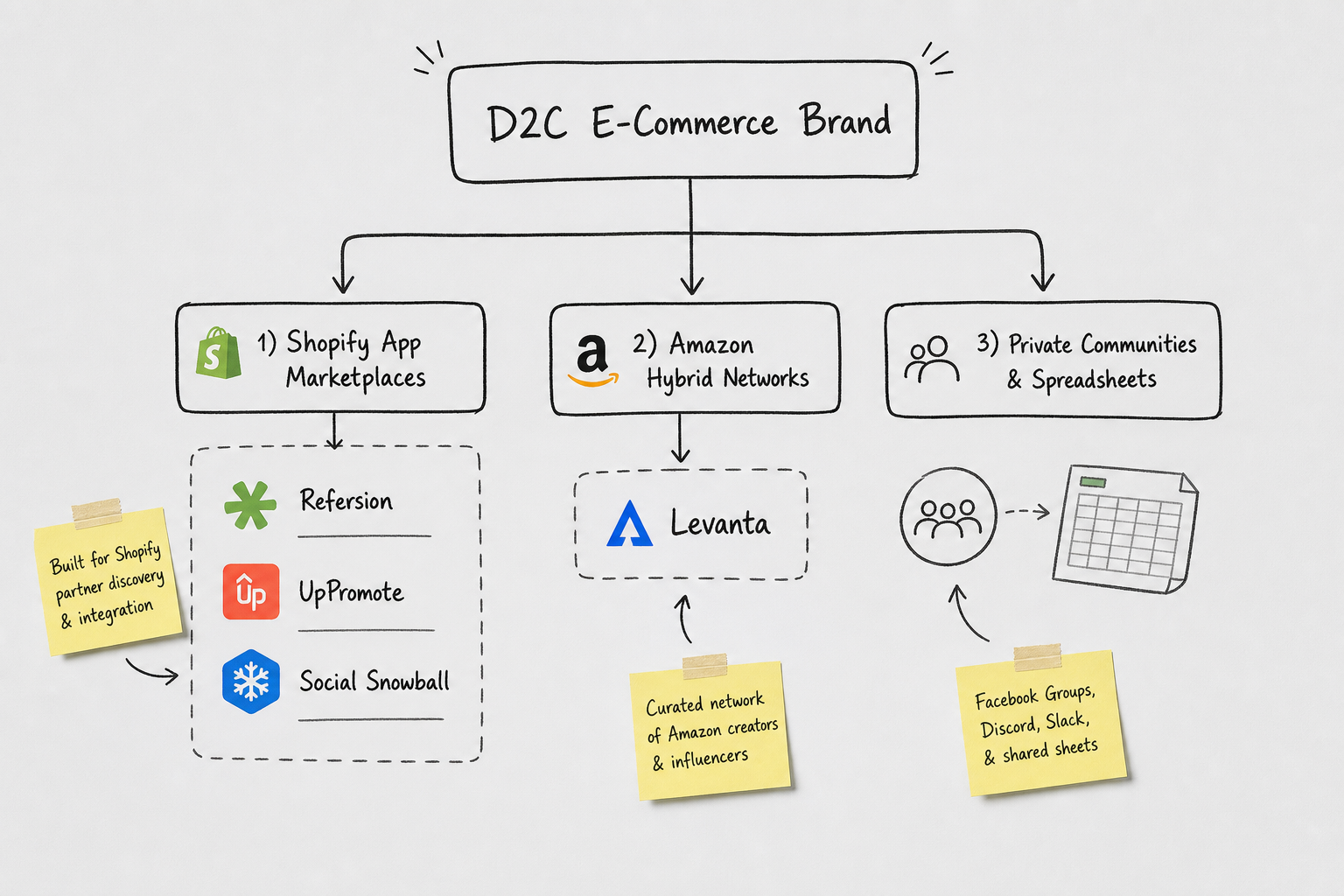
The most lucrative e-commerce affiliate programs are often the ones your competitors cannot easily find. Because many successful D2C brands view legacy networks as unnecessary overhead, they run their affiliate programs natively on their e-commerce platforms.
The Shopify App Store as a Directory
Shopify powers millions of e-commerce storefronts. Instead of joining a third-party network, these merchants install dedicated affiliate tracking apps directly into their Shopify backend.
If you want to uncover independent e-commerce partnerships, look at the public directories of these specific apps:
- Refersion: A massive player in the Shopify ecosystem. Refersion maintains an open marketplace where you can browse thousands of D2C brands across beauty, health, apparel, and specialized hobbies.
- UpPromote: Another highly popular Shopify app with an integrated marketplace. Because UpPromote is heavily utilized by emerging brands, you can frequently negotiate higher starting rates or secure exclusive promo codes before a brand becomes saturated with affiliates.
- Social Snowball: Built specifically for modern creators and word-of-mouth marketing, Social Snowball powers programs for highly trendy, aesthetic-driven D2C brands.
Leveraging Community Master Lists
Because the e-commerce landscape is so fragmented, industry professionals often bypass networks entirely and rely on peer-sourced data. Slack groups, private Discord communities, and specialized subreddits frequently compile and update master spreadsheets of high-converting, independent D2C programs.
Engaging in these communities not only helps you find unlisted programs but also gives you direct access to the affiliate managers who run them. A direct message to an in-house manager on LinkedIn or via a community Slack channel will secure an approval much faster than a generic application submitted through a faceless network directory.
Metrics That Matter When Browsing Directories
Finding a directory is only the first step. Once you are browsing thousands of potential partners, you have to filter out the poor performers. E-commerce affiliate marketing is ruthless; a brand with a beautiful website and a generous commission rate can still earn you absolutely nothing if their checkout process is broken.
When evaluating an e-commerce partnership, ignore the flashy marketing copy and look strictly at the data.
Earnings Per Click (EPC)
EPC is the single most important metric in any affiliate directory. It calculates the average amount of money earned by affiliates for every 100 clicks sent to the merchant.
If Brand A offers a 30% commission on a $100 product, and Brand B offers a 5% commission on a $100 product, amateur affiliates will blindly choose Brand A. But if Brand A's website converts at 0.5% and Brand B's website converts at 10%, Brand B will generate significantly more revenue. EPC normalizes these variables.
Look for 7-day and 30-day EPC metrics. A high historical EPC that has tanked in the last 7 days usually indicates the merchant has a broken tracking pixel or is currently out of stock on core items.
Cookie Duration (The Attribution Window)
When a user clicks your affiliate link, a cookie is placed in their browser. If they purchase within the lifespan of that cookie, you earn a commission.
In e-commerce, cookie length must align with the buyer's journey.
- Low-Ticket Items ($10 - $50): Impulse buys. A standard 7-day to 15-day cookie is usually sufficient.
- Mid-Ticket Items ($50 - $200): Requires some research. Demand a 30-day cookie minimum.
- High-Ticket Items ($500+): Mattresses, high-end electronics, enterprise SaaS. Buyers may research for weeks before converting. Look for 60-day, 90-day, or lifetime sticky cookies.
Average Order Value (AOV)
A high commission percentage on a low AOV item requires massive traffic volume to be profitable. Review the merchant's AOV in the directory. E-commerce brands that excel at cross-selling and upselling at checkout will naturally boost your commissions without requiring you to drive additional traffic.
Reversal Rates
This is the dark secret of e-commerce affiliate marketing. A network directory will show you how much money a brand generates, but you must also look at their reversal rate—the percentage of commissions they cancel or take back.
High reversal rates occur when a brand suffers from massive product returns, high credit card chargebacks, or worse, an affiliate manager who aggressively rejects valid sales to save the company money. Anything above a 5% reversal rate on physical goods is a massive red flag.
The B2B Angle: E-Commerce Infrastructure
When discussing e-commerce directories, the focus usually falls on physical products sold to consumers. However, one of the most lucrative angles is the B2B side of the industry: promoting the software and tools that e-commerce store owners need to run their businesses.
This is where a curated database shines. If you know how to pick a niche for affiliate marketing in 5 steps, you will quickly realize that selling a $30 t-shirt yields a $3 commission, but referring a merchant to an inventory management SaaS yields a recurring $50 monthly commission.
Promoting e-commerce infrastructure—hosting, email marketing platforms (like Klaviyo), SMS marketing tools (like Postscript), and page builders—is highly profitable. Because these are SaaS products, they frequently offer recurring commissions for the lifetime of the customer. Directories like AffiliList are explicitly designed to surface these types of SaaS and digital programs quickly, allowing you to filter for recurring payout models rather than one-time CPA (Cost Per Action) bounties.
3 Costly Mistakes When Using E-Commerce Directories
Navigating directories successfully requires strategy. Avoid these common failure modes that trap newer marketers.
1. Applying With an Empty Profile
When you request to join an e-commerce program on ShareASale, Impact, or CJ, the brand's affiliate manager reviews your application. If your network profile is blank, missing a description, or lacking verified traffic data, you will be auto-rejected.
Treat your directory profile like a business pitch. Clearly state your primary traffic sources, your target demographic, and exactly how you intend to promote their products. Include links to specific articles or social media channels where their brand will be featured.
2. Spreading Across Too Many Networks
Every time you join a new tracking network, you fragment your earnings. Most networks enforce a minimum payout threshold (usually $50 or $100). If you generate $30 on ShareASale, $40 on Impact, and $25 on Awin, you have generated $95 in total revenue but will receive zero payouts because you haven't crossed the threshold on any individual platform.
Consolidate your efforts. Use a discovery directory like AffiliList to map out where your ideal programs are hosted, and try to group your partnerships onto two or three primary tracking networks.
3. Ignoring the "Legitimacy" Trap
Not all programs listed in network directories are ethical or legitimate. Scammers occasionally slip through the vetting processes of massive platforms, offering astronomical commission rates on products that do not exist or are functionally useless.
Learning how to spot real offers is crucial. Always check the brand's organic web presence, read consumer reviews of their products, and test their customer service before recommending them to your audience. If you break your audience's trust by promoting a faulty e-commerce brand, you will permanently damage your conversion rates.
Adapting for Alternative Traffic Sources
Your choice of directory often depends on where your traffic comes from. Legacy networks were built for bloggers and coupon sites. If you drive traffic through alternative visual or video channels, you need programs that support specific promotional methods.
Social Media and Pinterest
If you run an affiliate marketing program for Pinterest or Instagram, you must ensure the e-commerce directory allows deep linking.
Deep linking is the ability to generate an affiliate link that points directly to a specific product page, rather than the brand's homepage. Pinterest traffic is highly visual and intent-driven. If a user clicks a pin of a specific leather jacket, they expect to land on that exact jacket. If your affiliate network only provides links to the brand's generic storefront, your conversion rate will plummet. Platforms like Impact and in-house Shopify apps handle deep linking seamlessly.
FAQs About E-Commerce Affiliate Directories
What is the easiest e-commerce network to get approved for?
ClickBank and Digistore24 require virtually no manual approvals, making them the easiest entry points for digital e-commerce. For physical products, ShareASale is generally highly welcoming to newer affiliates, though individual brands within the network may still enforce strict traffic requirements.
Do I have to pay to join an affiliate directory?
Legitimate tracking networks and discovery directories should rarely charge affiliates. Awin's $5 refundable deposit is an exception made purely for security. If a directory asks for a monthly subscription fee just to access their list of basic merchants, it is highly irregular and usually unnecessary given the wealth of free tools available.
Are traditional affiliate networks dying?
They are not dying, but their market share is diluting. Major enterprise brands still rely heavily on CJ Affiliate and Rakuten, and boutique retail still thrives on ShareASale. However, the explosive growth of D2C brands utilizing Shopify apps, combined with customized platforms like Impact, means that traditional networks are no longer the single source of truth for e-commerce partnerships.
Strategic Sourcing for Better Margins
Relying exclusively on ShareASale to find e-commerce partnerships is a fast track to promoting the exact same products as your competitors, often under unfavorable terms. The most successful affiliate marketers treat partnership sourcing as a core business function, not an afterthought.
By utilizing clean, specialized discovery directories to quickly analyze commission data without logging into twenty different dashboards, you streamline your workflow. When you combine curated databases with platforms like Impact for D2C brands, in-house Shopify apps for hidden gems, and specialized networks like Levanta for Amazon ecosystems, you build a diversified portfolio of high-converting, high-margin offers. Focus your research on strong EPCs, lengthy cookie durations, and reliable tracking technology to ensure every click you generate translates into captured revenue.