
Best Affiliate Program Finder for SAAS Lists Tools Beyond Shareasale
Discover top affiliate program finders and directories for B2B SaaS lists. Move beyond legacy networks like ShareASale to secure recurring MRR payouts.
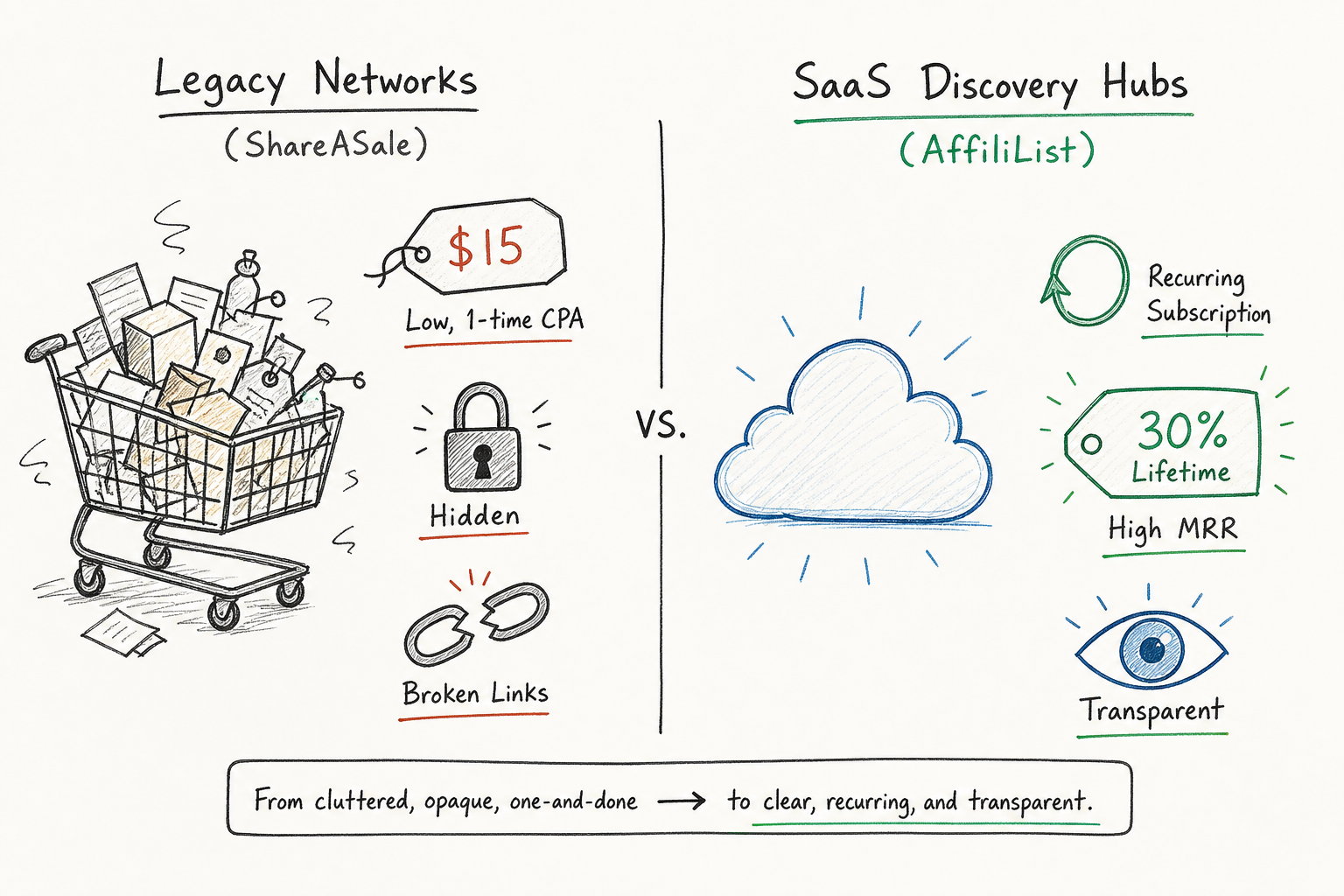
- Whiteboard diagram comparing legacy retail affiliate networks with modern SaaS discovery hubs showing MRR vs CPA features.
- Why Traditional Networks Shortchange SaaS Affiliates
- Dedicated SaaS Affiliate Directories and Discovery Hubs
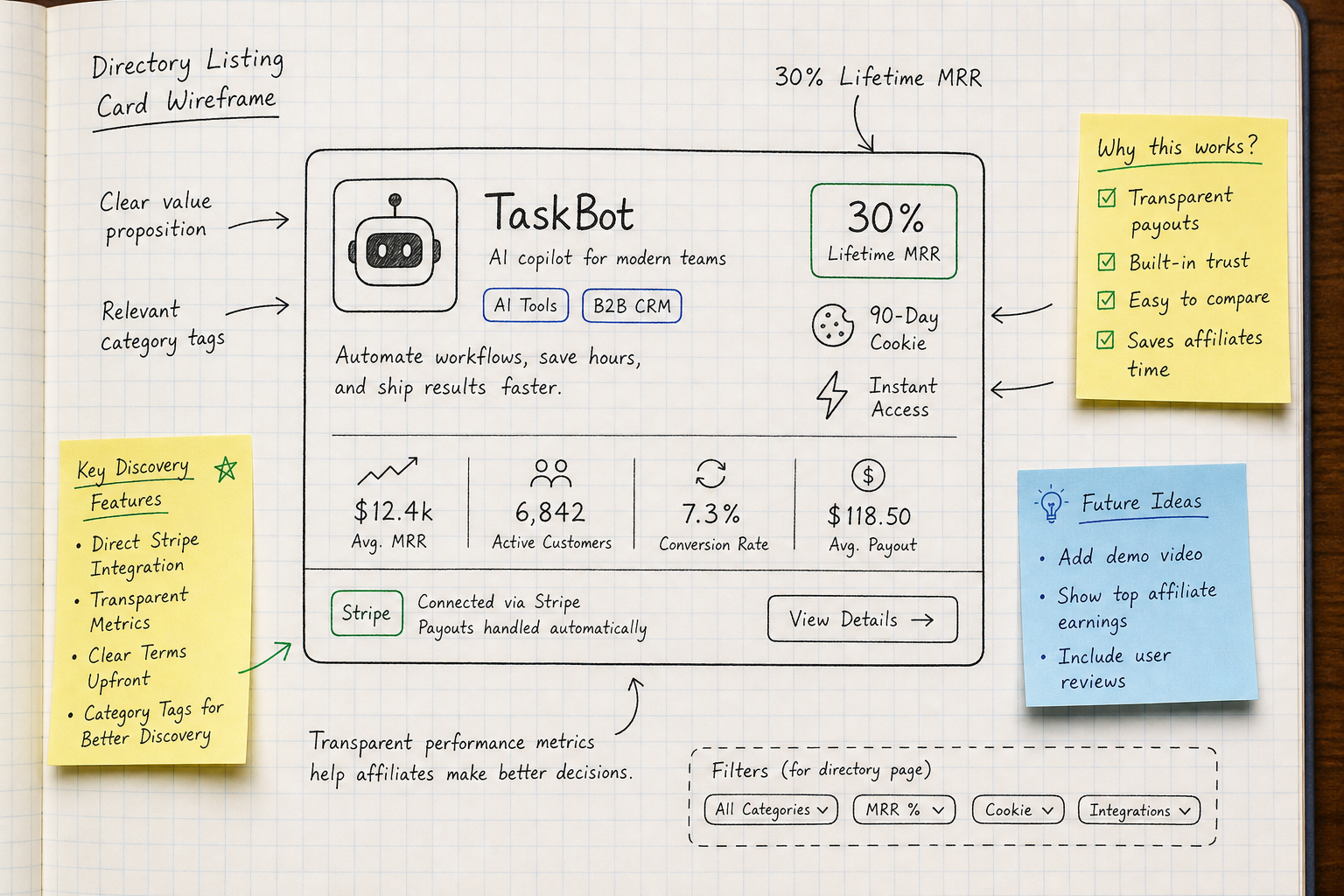
- Hand-drawn wireframe sketch of a modern SaaS affiliate listing card with transparent MRR and cookie metrics.
- Top B2B SaaS Partner Networks (Where Brands Actually Host Programs)
- How to Evaluate SaaS Program Finder Tools
- The 5-Step System for Selecting High-Converting SaaS Offers
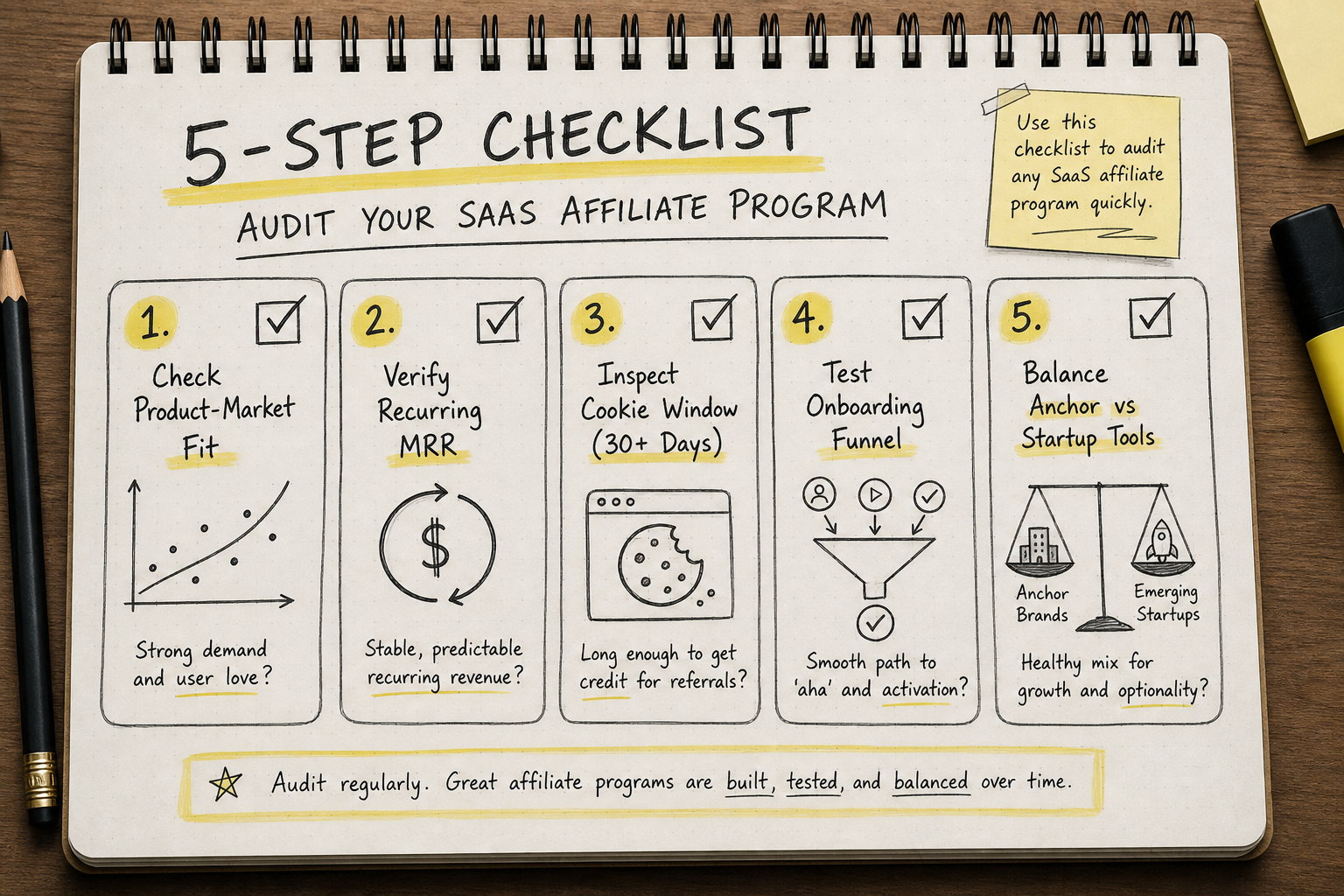
- Notebook sketch illustrating a 5-step checklist for evaluating high-converting SaaS affiliate offers.
- Real-World Case Study: Transitioning from ShareASale Retail to a $4,500/Mo SaaS Portfolio
- Myth-Busting: You Must Use Large Affiliate Networks to Earn High Commissions
- How Software Vendors List Their Programs for Maximum Exposure
- Strategic Action Plan: Building Your High-Yield SaaS Portfolio
- Frequently Asked Questions
- What makes a SaaS affiliate program finder different from a traditional affiliate network?
- How do I find direct SaaS affiliate programs that aren't listed on ShareASale?
- Are recurring commissions in SaaS affiliate marketing guaranteed for life?
- How can I verify if a SaaS affiliate program is legitimate before promoting it?
- Final Thoughts
Finding high-yielding software affiliate programs on traditional networks like ShareASale often feels like searching for modern software tools in a digital flea market. Legacy networks were built for physical e-commerce, low-margin retail products, and one-time transactional commissions. If you spend hours sifting through ShareASale or CJ Affiliate hoping to build a portfolio of recurring B2B software offers, you will encounter outdated merchant listings, broken application forms, hidden commission terms, and low one-time payouts.
Software as a Service (SaaS) affiliate marketing operates under a completely different economic engine. SaaS companies offer high-margin monthly recurring revenue (MRR), lifetime customer values, 30-day to 90-day cookie windows, and generous 20% to 50% recurring payouts. To find these high-converting offers, you need specialized discovery platforms, dedicated software directories, and modern B2B partner ecosystems.
This guide details the best affiliate program finder tools for SaaS lists that go far beyond ShareASale, giving you direct access to high-paying software offers without unnecessary sign-up friction.
Why Traditional Networks Shortchange SaaS Affiliates
Legacy affiliate networks like ShareASale, CJ (Commission Junction), and ClickBank dominated early internet marketing. However, their architecture and business models were designed around physical products, consumer retail, and digital information courses. When applied to modern B2B and SaaS software tools, these platforms fall short in four specific areas.
1. Hidden Program Details Behind Application Walls
On traditional networks, critical program details are hidden behind gatekeeper barriers. You are often required to apply to the network, wait days for manual review, and then apply individually to every single merchant before you can view full commission rates, payout schedules, cookie durations, or landing page options. This friction creates massive delays when researching market verticals or planning content schedules.
2. Lack of Support for Recurring MRR Commission Tracking
SaaS profitability relies on recurring revenue. When you refer a user to a CRM or email marketing platform, you earn a percentage of their subscription every month for 12 months, 24 months, or the lifetime of the account. Traditional networks prioritize one-time Cost Per Acquisition (CPA) payments. Their payout dashboards and tracking infrastructure struggle with dynamic monthly subscription tiers, seat upgrades, or annual billing cycles common in modern software products.
3. Outdated Category Taxonomies and Search Filters
Legacy network search engines categorize products into broad, outdated buckets like "Services" or "Computers & Electronics." Searching for niche SaaS subcategories—such as AI video generators, headless CMS tools, cold email infrastructure, or product analytics—yields irrelevant or defunct listings. Finding top-tier options in the best niches for affiliate marketing requires granular tagging, not generic retail subcategories.
4. Heavy Network Fees Driving SaaS Founders Away
Traditional networks charge merchants expensive setup fees and take a substantial cut of total payouts. Consequently, modern SaaS founders rarely launch programs on ShareASale or CJ. Instead, software startups host their partner programs on specialized SaaS engines like FirstPromoter, Rewardful, or PartnerStack, or list their offers on open affiliate directories.
+---------------------------------------------------------------------------------------+
|                             TRADITIONAL VS. SAAS NETWORKS                             |
+------------------------------------+--------------------------------------------------+
| Feature                            | Legacy Networks (ShareASale, CJ)                 | Modern SaaS Directories & Hubs   |
+------------------------------------+--------------------------------------------------+
| Primary Product Type               | E-commerce, Retail, Physical Goods               | Cloud Software, B2B Web Apps     |
| Payout Model                       | One-time CPA / Flat Fee                          | Monthly Recurring Revenue (MRR)  |
| Transparency                       | Hidden behind application approval               | Open-access commission metrics   |
| Search Taxonomy                    | Generic ("Electronics", "Services")              | Hyper-specific SaaS categories   |
| Tracking Infrastructure            | Pixel tracking, static links                     | Stripe integration, API-driven   |

+------------------------------------+--------------------------------------------------+
Dedicated SaaS Affiliate Directories and Discovery Hubs
If you want an efficient way to discover software programs without jumping through application hoops, dedicated SaaS lists and curated directories provide the best entry point. These platforms aggregate thousands of verified programs, allowing you to compare commission rates, payout terms, and category demand instantly.
1. AffiliList
AffiliList is built specifically to address the pain points of traditional affiliate networks. It serves as an open-access directory with a database of over 10,000 verified affiliate programs, placing a heavy focus on SaaS, cloud software, and digital tools.
Unlike legacy databases that hide program specifics, AffiliList provides complete transparency. Marketers can view commission percentages (MRR vs. CPA), cookie windows, payout mechanisms, and target landing pages without creating an account or waiting for merchant clearance.
- Key Strengths: Deep category tagging (from AI prompts and developer platforms to HR tech and SEO software), advanced filtering by commission rate, clutter-free UI, and a dedicated merchant submission portal ensuring fresh listings.
- Best For: Content creators, niche site owners, and performance marketers who need to fast-track market research and build high-converting software lists across specific verticals.
2. SaaSHub
While SaaSHub is primarily known as an independent software directory and alternative-finder for digital tools, it serves as an excellent research hub for affiliate marketers. SaaSHub catalogs tens of thousands of software products alongside their direct competitors.
- Key Strengths: Listings feature direct indicators showing whether a software vendor runs an active affiliate or referral program. By searching popular enterprise tools on SaaSHub, you can identify lesser-known, high-commission alternatives that offer generous partner splits.
- Best For: Uncovering emerging software competitors and identifying market alternatives with active referral programs.
3. SaaSAffiliate
SaaSAffiliate focuses exclusively on software-as-a-service partnership opportunities. The directory indexes B2B software listings across categories like CRM, marketing automation, cyber security, and project management.
- Key Strengths: Clear categorization by payout structure, allowing creators to filter specifically for recurring monthly commissions versus upfront single-payout options.
- Best For: B2B bloggers looking specifically for long-tail SaaS offers with monthly recurring revenue models.
4. AffiliatePrograms.com
AffiliatePrograms.com is a broader directory that features an active, well-maintained B2B and SaaS section. It catalogs software programs based on merchant reputability, payout reliability, and cookie lengths.
- Key Strengths: Detailed program reviews and community rating scores that help marketers separate established software merchants from unverified offers.
- Best For: Cross-referencing program reliability and finding high-paying options in established software verticals.
Top B2B SaaS Partner Networks (Where Brands Actually Host Programs)
Directories help you discover and compare options, but you still need access to the platforms where SaaS companies manage tracking, payouts, and affiliate assets. The following specialized SaaS networks have largely replaced ShareASale for software partnerships.
PartnerStack
PartnerStack is the primary partner platform for B2B SaaS companies. Industry leaders like Monday.com, Notion, Webflow, and Asana manage their affiliate, referral, and reseller programs on PartnerStack.
- Built-in Marketplace: PartnerStack features a public directory of modern SaaS affiliate programs. Once approved for a main PartnerStack account, you can join dozens of top-tier software programs with a single click.
- Unified Dashboard: All metrics, links, payout schedules, and promo assets are managed in a single interface, making it easy to track complex MRR payouts across multiple tools.
- Co-Marketing Features: Top vendors on PartnerStack frequently provide specialized lead magnets, custom discount codes, and dedicated landing pages for high-performing partners.
Impact (Impact Radius)
Impact is an enterprise-level partnership management engine used by larger SaaS brands and tech platforms, including Canva, Shopify, and HubSpot.
- Advanced Attribution: Impact offers robust custom contracting terms, multi-touch attribution, and flexible cookie tracking windows.
- Dynamic Commission Tiers: Software merchants on Impact often structure performance tiers, increasing your commission percentage as you reach specific monthly referral thresholds.
FirstPromoter & Rewardful Networks
Many growth-stage SaaS startups do not list on centralized affiliate marketplaces. Instead, they run direct, white-labeled partner programs powered by backend tracking engines like FirstPromoter or Rewardful.
- Stripe Integration: These platforms integrate directly with the vendor’s Stripe account, ensuring accurate automated tracking of subscriber renewals, upgrades, and cancellations.
- Direct Merchant Relationships: When joining a program hosted on FirstPromoter or Rewardful, you work directly with the software company’s internal growth manager rather than a middleman network representative.
- How to Find Them: Look for "Affiliates" or "Partners" links in the site footers of your favorite software tools. Alternatively, open-access tools like AffiliList index these direct Stripe-backed programs, saving you from manual footer searching.
+---------------------------------------------------------------------------------------+
|                         SAAS PARTNER ECOSYSTEM COMPARISON                             |
+-------------------+----------------------+-------------------+------------------------+
| Platform / Tool   | Network Type         | Payout Focus      | Access Barrier         |
+-------------------+----------------------+-------------------+------------------------+
| AffiliList        | Curated Directory    | MRR & CPA         | Open Access (Instant)  |
| PartnerStack      | B2B SaaS Marketplace | Monthly MRR / Split| Single Platform Review |
| Impact            | Enterprise Network   | Tiered CPA & MRR  | Individual Approval    |
| Rewardful Engine  | Direct Stripe Plugin | Lifetime MRR      | Direct Merchant Review |
| SaaSHub           | Software Directory   | Mixed / Referral  | Open Access (Instant)  |

+-------------------+----------------------+-------------------+------------------------+
How to Evaluate SaaS Program Finder Tools
Not all program finders and directories offer equal value. To evaluate directory tools and program discovery platforms, weigh these five core criteria.
1. Data Transparency and Barrier to Entry
The best discovery tools display commission percentages, cookie durations, minimum payout thresholds, and payout methods publicly. Avoid platforms that require long application forms or personal contact details just to view basic program terms.
2. Database Freshness and Link Health
SaaS startups scale quickly, pivot often, and occasionally close down. A quality affiliate finder actively prunes broken link destination URLs, updates expired commission structures, and regularly adds newly launched software tools.
3. Depth of Taxonomy and Search Tagging
Generic keyword search is insufficient when building targeted software listicles. Look for tools that organize listings by detailed use cases (such as "AI Copywriting," "Cold Email Infrastructure," or "Headless E-commerce") rather than high-level headers like "Software."
4. Direct Merchant Verification
Directories that pull unverified listings create friction when program links don't match merchant terms. Look for directories that offer verified merchant submission portals or direct API-checked listings.
5. Clarity on Payout Mechanics (MRR vs. Flat CPA)
In SaaS affiliate marketing, a 30% recurring lifetime commission on a $100/month tool yields far more value than a single $50 flat CPA payout. Your program finder must distinguish between continuous monthly recurring revenue (MRR), capped recurring split, and one-time CPA offers.
If you are exploring new ways to convert traffic outside traditional search engines, review our walkthrough on setting up affiliate marketing on Pinterest to drive direct traffic to your software roundups.
The 5-Step System for Selecting High-Converting SaaS Offers
Discovering a software list on an affiliate program finder is only the first step. You must analyze each offer to ensure it will convert your audience and generate reliable long-term revenue. Follow this five-step evaluation system.
+---------------------------------------------------------------------------------------+
|                    THE 5-STEP SAAS PROGRAM SELECTION SYSTEM                           |
|                                                                                       |
|  [Step 1] Verify Software Product-Market Fit & Churn Metrics                          |
|         │                                                                             |
|         ▼                                                                             |
|  [Step 2] Deconstruct Commission Structure (MRR Duration vs. One-Time CPA)            |
|         │                                                                             |
|         ▼                                                                             |
|  [Step 3] Evaluate Cookie Window & Attribution Rules (30+ Days Minimum)              |
|         │                                                                             |
|         ▼                                                                             |
|  [Step 4] Inspect Onboarding Funnels & Conversion Assets                              |
|         │                                                                             |
|         ▼                                                                             |
|  [Step 5] Balance Portfolio Across Anchor Tools & Fast-Growing Startups               |

+---------------------------------------------------------------------------------------+
Step 1: Verify Software Product-Market Fit and Low Churn
High recurring commissions are meaningless if customers cancel their subscriptions after thirty days. Evaluate the tool’s user satisfaction, software stability, and customer feedback on review sites like G2 or Capterra. Look for tools with low churn rates and established product-market fit. High retention ensures your monthly recurring commissions build up over time.
Step 2: Deconstruct the Commission Structure
Examine the exact payout terms before adding a software tool to your content matrix:
- Lifetime Recurring MRR: You earn a flat percentage (e.g., 30%) for as long as the user keeps their paid subscription active. This is the ideal SaaS commission model.
- Capped Recurring MRR: You earn recurring commissions for a limited window, such as the first 12 months of a user's subscription.
- One-time CPA: You receive a single flat payment (e.g., $150) upon initial user conversion. This model works best for low-priced entry tools or free-trial signups with strict qualification criteria.
When evaluating financial returns across different models, read our analysis on high paying affiliate programs for $500+ commissions to compare high-ticket CPA offers against recurring SaaS models.
Step 3: Evaluate Cookie Duration and Attribution Rules
Software buying decisions take time. B2B prospects often register for a demo, consult team members, and compare alternatives before subscribing. Look for SaaS programs that offer at least a 30-day cookie window, with 60-day or 90-day windows preferred. Pay attention to attribution rules; first-click attribution favors top-of-funnel educational review content, while last-click attribution favors comparison lists and discount queries.
Step 4: Test Onboarding Funnels and Merchant Assets
Sign up for a free trial of the software yourself. Experience the merchant’s user onboarding, email welcome sequence, and payment flow. Check if the merchant provides assets to support your promotion:
- Custom co-branded landing pages with tailored discount banners.
- Pre-tested banner ads, brand assets, and product interface screenshots.
- Dedicated affiliate managers who provide conversion stats, demo access, or custom deal codes.
Step 5: Balance Anchor SaaS Tools with Fast-Growing Startups
Diversify your software portfolio across established market leaders and fast-growing startups:
- Anchor Tools: Market leaders with high brand awareness and predictable conversion rates. These tools usually offer lower commission rates (15%-20%), but convert consistently due to established brand trust.
- Fast-Growing Startups: Newer tools competing aggressively for market share. They often offer high commission splits (30%-50% recurring) and longer cookie windows to attract creator promotion.
Real-World Case Study: Transitioning from ShareASale Retail to a $4,500/Mo SaaS Portfolio
To understand how shifting from legacy networks to specialized SaaS program finders impacts long-term earnings, consider this real-world operational scenario.
The Background
Marcus ran a technology site focused on productivity workflows, remote work strategies, and digital creator tools. For two years, he relied entirely on ShareASale and Amazon Associates to monetize his site. His content produced over 40,000 monthly visits, but his monthly affiliate revenue hovered between $600 and $850.
The Problem
- Low Margins: Amazon's physical tech commissions sat between 1% and 3%. ShareASale’s retail software tools paid average one-time CPAs of $10 to $25.
- High Churn and Zero Compounding: Every month, Marcus's affiliate balance reset to zero. If his organic search traffic dipped, his monthly payout dropped immediately.
- Outdated Merchants: Promoted software offers on ShareASale frequently experienced high cart abandonment due to outdated checkout pages and lack of mobile optimization.
The Strategy Shift
Marcus audited his site's revenue model and shifted his monetization strategy toward recurring B2B software partnerships:
- Discovery & Auditing: Marcus used AffiliList to research high-converting alternatives across specific software categories (such as AI scheduling, cloud CRM, and project tracking). He prioritized offers with 30%+ recurring lifetime commissions.
- Network Onboarding: Instead of applying to broad networks, he set up account dashboards on PartnerStack and joined direct FirstPromoter-backed affiliate programs for top-tier SaaS tools.
- Content Restructuring: He updated broad roundups into direct alternative comparisons (e.g., "Tool A vs. Tool B") and launched detailed workflow tutorials showcasing high-converting SaaS applications.
The Results After 8 Months
- Total Active Recurring Referrals: 185 active software subscriptions across 6 core B2B tools.
- Monthly Recurring Revenue (MRR): $4,520 in reliable, automated monthly payouts.
- Revenue Retention: Even during months with lower search traffic, his baseline affiliate earnings remained stable due to ongoing monthly subscription renewals.
+---------------------------------------------------------------------------------------+
|                    MONETIZATION STRATEGY TRANSITION COMPARISON                        |
+-----------------------------------+---------------------------------------------------+
| Metrics                           | Legacy ShareASale / Retail Model                  | Dedicated SaaS Portfolio Strategy |
+-----------------------------------+---------------------------------------------------+
| Primary Offer Type                | Single-payout hardware & course CPAs             | Lifetime Monthly Recurring Revenue|
| Average Payout per Sale           | $15.00 (One-time)                                 | $32.00 / month (Recurring)        |
| Revenue Stability                 | Drops to zero if traffic dips                     | Baseline recurring revenue remains|
| Monthly Revenue at Month 8        | $780.00                                           | $4,520.00                         |
| Primary Discovery Method          | Manual network searches                           | Curated SaaS directories & stacks |

+-----------------------------------+---------------------------------------------------+
If you are structuring a new content site around software reviews, check out our step-by-step roadmap on how to start a profitable affiliate marketing blog to build a solid foundation.
Myth-Busting: You Must Use Large Affiliate Networks to Earn High Commissions
A common misconception in performance marketing is that you must join major legacy networks like ShareASale, CJ, or Awin to find legitimate, high-paying offers.
Myth: Direct SaaS Programs and Independent Directories Aren't Safe
Some creators assume that unless a corporate network acts as a middleman, they risk missing payments or experiencing faulty click tracking.
Fact: Modern SaaS Infrastructure is More Accurate Than Legacy Networks
Modern software vendors build their affiliate programs directly on top of billing infrastructure like Stripe, Chargebee, or Paddle using modern tracking engines like Rewardful, FirstPromoter, or Tolt.
When a user clicks your link and purchases a subscription, tracking occurs directly at the billing and API layer rather than relying on legacy browser pixels. Payouts are calculated automatically based on real invoice settlement, reducing tracking errors and attribution disputes.
Furthermore, by eliminating third-party network fees, software founders can allocate a larger portion of customer acquisition costs directly to creator commission payouts. This structure explains why software companies regularly offer 30% to 50% recurring MRR splits when you join through open SaaS directories or direct partner pages.
For a deeper dive into verifying software program legitimacy and avoiding unverified offers, read our guide on is affiliate marketing legit and how to spot real offers.
How Software Vendors List Their Programs for Maximum Exposure
If you are a SaaS founder or partner manager looking to build an affiliate engine, understanding how affiliates source programs is key to scaling your partner channel.
1. Submit to Curated Open Directories
Affiliates frequently consult open-access databases like AffiliList, SaaSHub, and SaaSAffiliate when building content matrices. Listing your program on these platforms ensures your offer is visible to creators researching specific software niches without application barriers.
2. Embed a Clear Footer Link
Ensure your website footer includes an explicit link to your "Affiliate Program" or "Partners." Software reviewers use automated scrapers and manual site audits to check footers for active partner links.
3. Be Upfront with Your Commission Terms
Display your commission rates, cookie duration, and payout schedules clearly on your affiliate landing page. Concealing payment details behind an application wall turns away experienced performance marketers who evaluate metrics before applying.
If you are looking to enter the industry from an operational or management standpoint, explore current opportunities in our guide on affiliate marketing jobs.
Strategic Action Plan: Building Your High-Yield SaaS Portfolio
To transition away from cluttered legacy networks and capture high-margin SaaS commissions, put this five-point strategic plan into action.
+---------------------------------------------------------------------------------------+
|                    ACTION PLAN FOR HIGH-MARGIN SAAS AFFILIATES                        |
+---------------------------------------------------------------------------------------+
| 1. Clear Out Low-Yield Retail Offers                                                  |
|    Audits existing content and replace low-margin physical/CPA links with recurring   |
|    SaaS software alternatives.                                                        |
|                                                                                       |
| 2. Source Programs via Curated Directories                                            |
|    Use platforms like AffiliList to identify high-converting B2B software tools in    |
|    your niche with transparent 30%+ recurring payout terms.                           |
|                                                                                       |
| 3. Centralize SaaS Network Management                                                 |
|    Establish partner dashboards on modern platforms like PartnerStack, FirstPromoter, |
|    and Rewardful for easy link creation and metric tracking.                          |
|                                                                                       |
| 4. Publish High-Intent Software Content                                               |
|    Focus on bottom-of-funnel formats: "Best [Category] Tools", direct alternative      |
|    comparisons, and step-by-step workflow tutorials.                                  |
|                                                                                       |
| 5. Reinvest Recurring Revenue into Content Scale                                      |
|    Use predictable MRR payouts to fund new software tests, hire content creators, and  |
|    expand into adjacent B2B software categories.                                      |

+---------------------------------------------------------------------------------------+
If you are exploring broader market opportunities beyond software tools, review our comprehensive guides on 9 profitable affiliate marketing niches and learn how to pick a niche for affiliate marketing in 5 steps.
Frequently Asked Questions
What makes a SaaS affiliate program finder different from a traditional affiliate network?
A SaaS affiliate program finder operates primarily as an open search directory and discovery index specifically built for software tools. Unlike traditional networks (such as ShareASale or CJ), which act as gated middlemen with mandatory sign-ups and locked program details, open SaaS finders like AffiliList provide instant access to verified program terms, commission structures, cookie durations, and category tags without application delay.
How do I find direct SaaS affiliate programs that aren't listed on ShareASale?
You can discover non-network SaaS affiliate offers using three effective methods:
- Search curated SaaS directories like AffiliList, SaaSHub, or SaaSAffiliate.
- Check the footer links of target software websites for "Partners" or "Affiliate Program."
- Explore modern B2B SaaS partnership marketplaces like PartnerStack, or look for direct Stripe-integrated programs running on FirstPromoter and Rewardful.
Are recurring commissions in SaaS affiliate marketing guaranteed for life?
Recurring payouts depend on the merchant's specific affiliate terms. Many SaaS vendors offer true "lifetime recurring" commissions, paying you a monthly percentage for as long as the referred customer remains subscribed. Other vendors cap recurring payouts at 12 or 24 months, or pay a higher one-time flat CPA. Always check the payout terms listed in open directories like AffiliList before joining.
How can I verify if a SaaS affiliate program is legitimate before promoting it?
To confirm a SaaS program's legitimacy, check that the vendor uses an established tracking infrastructure (like PartnerStack, Rewardful, FirstPromoter, or Impact). Ensure they provide clear terms of service, clear payout minimums, reliable customer feedback on G2 or Capterra, and a responsive partner management contact.
Final Thoughts
Relying on traditional networks like ShareASale for SaaS program discovery is inefficient. Modern software affiliates require tools built specifically for the software ecosystem—platforms that prioritize transparent recurring commission data, deep category search, and low-friction access.
By leveraging dedicated SaaS program finders like AffiliList, tapping into modern B2B networks like PartnerStack, and evaluating software vendors based on product stability and customer retention, you can build a stable, monthly recurring revenue portfolio that grows month after month.
To start mapping out your monetization strategy, review our step-by-step execution guide on building an affiliate marketing side hustle or explore top-performing verticals in our guide to the most profitable affiliate marketing niches.